Rome-Washington Strategic Reset: Rubio’s Diplomatic Mission Amidst Global Tensions

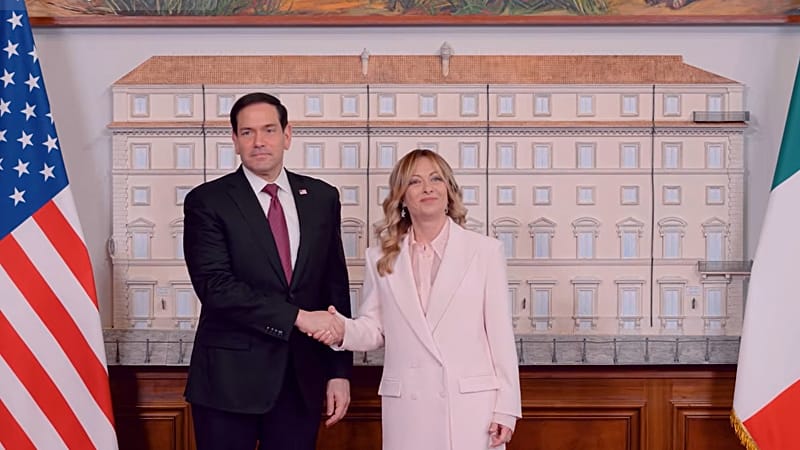
In the early months of 2026, the geopolitical landscape of the West faces a litmus test. As international conflicts expand and trade policies shift toward protectionism, US Secretary of State Marco Rubio’s recent visit to Rome serves as a critical bridge—and a potential point of fracture—between the United States and its European allies. With meetings held at the Vatican, the Farnesina, and Palazzo Chigi, the message was clear: the transatlantic alliance is being recalibrated for a new, volatile era.
The discussions between Rubio, Prime Minister Giorgia Meloni, and Foreign Minister Antonio Tajani were not merely ceremonial. They addressed the most pressing crises of the year, from the ongoing instability in the Middle East and the war against Iran to the looming threat of US-imposed tariffs on the European automotive sector.
The Middle East Conundrum: Iran and the Strait of Hormuz
The primary focus of the high-level talks in Rome was the escalating conflict in the Middle East. Secretary Rubio arrived in Italy with a clear mandate: to secure greater European alignment with Washington’s strategic objectives regarding Iran.
Italy’s Balancing Act
Prime Minister Meloni and Foreign Minister Tajani have found themselves in a delicate position. While Italy remains a steadfast member of NATO and a key US partner, the Italian government has emphasized the necessity of diplomatic channels to prevent a broader regional conflagration.
During the meetings, Rubio updated Italian leadership on the current state of operations against Iran, citing the global danger posed by the regime. However, Italy continues to push for a multilateral approach. Minister Tajani reiterated Italy’s commitment to freedom of navigation, confirming that if conditions align, Rome is prepared to contribute to a multilateral naval initiative in the Strait of Hormuz. This defensive stance aims to protect international trade routes without necessarily committing to an offensive posture that could alienate other European partners.
The Lebanon Factor
The situation in Lebanon was another critical agenda item. Rubio acknowledged Italy’s unique position, noting that due to its presence on the ground and regional expertise, Rome can play a pivotal role in mediating a ceasefire. Diplomats expect further talks on this issue in the coming week, signaling that the US is actively looking to leverage Italy’s “soft power” to achieve hard-security outcomes.
Trade Wars and the “Big Market” Vision
Beyond the immediate theater of war, the specter of economic protectionism looms large. President Donald Trump’s recent threats of imposing high tariffs on the automotive sector have sent shockwaves through Brussels and Rome.
Defending European Interests
Foreign Minister Tajani used the meetings to push back against the narrative of trade wars. He explicitly stated that Italy—and by extension, the EU—is in favor of a “big market” that encompasses the US, Canada, Mexico, and Europe. The Italian strategy is to steer Washington away from isolationist policies by emphasizing the economic interdependence of Western nations.
Rubio, while representing the administration’s “America First” priorities, attempted to frame the economic discussions within the broader context of security. The US State Department’s post-meeting note emphasized that Western nations must “protect their economic interests,” a phrase that suggests the US is willing to negotiate on trade if European nations provide more robust support on security and defense spending.
NATO, Troop Deployments, and European Autonomy
One of the most sensitive topics discussed was the future of US military presence in Europe. President Trump’s rhetoric regarding the withdrawal of troops from countries deemed “insufficiently supportive” of US foreign policy objectives has created an atmosphere of uncertainty.
A Strong Proponent of NATO
Secretary Rubio sought to clarify the American stance, positioning himself as a “strong supporter of NATO.” He explained that the potential for relocating forces is not necessarily a move toward isolationism, but rather a strategic adjustment. He noted that the US requires flexible forces that can be deployed to various global emergency situations, hinting that the current static placement of troops may not be the optimal configuration for 2026.
Notably, Rubio clarified that the US has not officially decided on a withdrawal from Italy, though he warned that past experiences—such as Spain denying the use of bases—have created “unnecessary dangers” for the US military. This serves as a clear warning to European capitals: strategic access to bases is the price of continued American security guarantees.
Strengthening the Transatlantic Bond
Despite the tensions, the visit was framed by both sides as a “positive meeting.” The relationship between Meloni and the Trump administration remains one of the most important in Europe, even as it experiences the friction of competing national interests.
Diplomatic Continuity
The discussions were described as “constructive, frank, and productive.” By covering a wide range of topics—including the situation in Ukraine, the instability in Libya, and the influence of China—the US and Italy are attempting to maintain a unified front. The meeting also had a personal touch, with Rubio presenting a family tree tracing his Piedmontese roots, a gesture that highlighted the deep historical and cultural ties that bind the two nations regardless of political cycles.
The Road Ahead: 2026 and Beyond
As we move further into 2026, the success of this diplomatic engagement will be measured by two factors:
- The Iran Resolution: Whether Italy and the EU can find a middle ground that supports US security goals without triggering a full-scale regional war.
- The Tariff Tussle: Whether the “big market” vision promoted by Tajani can prevent a damaging trade war between the US and the European Union.
The stakes are high. If the US and its European allies fail to coordinate their economic and military strategies, the resulting vacuum will likely be filled by adversaries looking to exploit the divide. For now, the dialogue remains open, and the strategic partnership, though strained, holds firm.
Conclusion
Secretary Rubio’s visit to Rome underscores the complexity of modern diplomacy. The US is no longer content with the status quo of the post-Cold War era. Washington is demanding more from its allies—more support in the Middle East, more investment in defense, and more alignment on trade. Italy, for its part, is navigating these demands with a pragmatic approach, seeking to maintain its role as a bridge between the Atlantic powers while protecting its own economic and regional interests.
As the year progresses, the world will be watching to see if this “positive meeting” translates into tangible policy shifts. The alliance between the US and Italy is not just about historical ties; it is about the future of the Western order in an increasingly fragmented world.