Labour Party Crisis 2026: Catherine West Issues Monday Ultimatum to Oust Sir Keir Starmer

The British political landscape has been rocked by a seismic shift as the Labour Party faces its most significant internal crisis since taking power. Following a catastrophic set of local election results in May 2026, the Prime Minister, Sir Keir Starmer, finds himself fighting for his political life. The catalyst for this immediate showdown is Catherine West, the MP for Hornsey and Friern Barnet, who has issued a chilling ultimatum to the Cabinet: challenge the Prime Minister by Monday, or she will trigger a formal leadership contest herself.
This move has effectively put the government “on notice,” turning the upcoming Monday into a potential “Day of Reckoning” for a premiership that many insiders now describe as “terminal.”
The Ultimatum: Catherine West’s Bold Move
Catherine West, a former foreign minister who was sacked by Starmer in September 2025, has emerged as the unlikely “stalking horse” in this high-stakes drama. Speaking to BBC Radio 4, West made her position clear: the time for “reset speeches” and “reflection” has passed. She has demanded that the Cabinet take decisive action to replace Starmer with a leader who can better communicate the party’s message.
“My preferred option is for the Cabinet to do a reshuffle within itself,” West stated. She suggested that Starmer be moved to an international role, a position she believes would better suit his skill set, while allowing “fresh talent” to take the helm of the domestic agenda. By setting a deadline for Monday, West has forced the hand of senior ministers who have, until now, remained publicly loyal despite private misgivings.
The 81-MP Threshold: Can She Do It?
Under current Labour Party rules, a leadership challenge requires the backing of at least 20% of the parliamentary party. In the context of 2026, this translates to a minimum of 81 Labour MPs. While critics argue that West may struggle to find such numbers, supporters point to the “unbelievable frustration” brewing within the party.
One moderate MP described West as a “hero,” suggesting that her move might finally “kick the Cabinet into doing the right thing.” The expectation is that while the Left of the party will sign on immediately, more moderate MPs—waiting to see the content of Starmer’s promised “reset speech”—may add their names if the Prime Minister fails to inspire confidence.
The 2026 Local Election Bloodbath: A Mandate Lost?
The urgency of West’s ultimatum is driven by the worst local election results in Labour’s history. The party has seen a total collapse in its traditional heartlands, losing over 1,400 council seats across England, Scotland, and Wales.
The Fall of the “Red Wall” and the Rise of Reform UK
In South Yorkshire, the loss of Barnsley—a Labour stronghold for over 50 years—to Reform UK has sent shockwaves through the party. Reform UK, led by Nigel Farage, has capitalized on voter dissatisfaction with the cost-of-living crisis and immigration policies, gaining a staggering 1,276 seats nationally.
In Bradford and Tower Hamlets, the story was different but equally damaging. Labour lost control as “Muslim-first” groups and independent candidates surged, largely in protest against the government’s foreign policy stances.
A Historic Defeat in Wales
For the first time since devolution, Labour has been kicked out of the Welsh Government. The Senedd elections saw Plaid Cymru emerge as the largest party, with Reform UK taking second place. The loss of Wales is perhaps the most stinging indictment of Starmer’s leadership, signaling that the “Labour brand” is no longer a guarantee of success in its most loyal territories.
Starmer’s Survival Strategy: The Return of the Old Guard
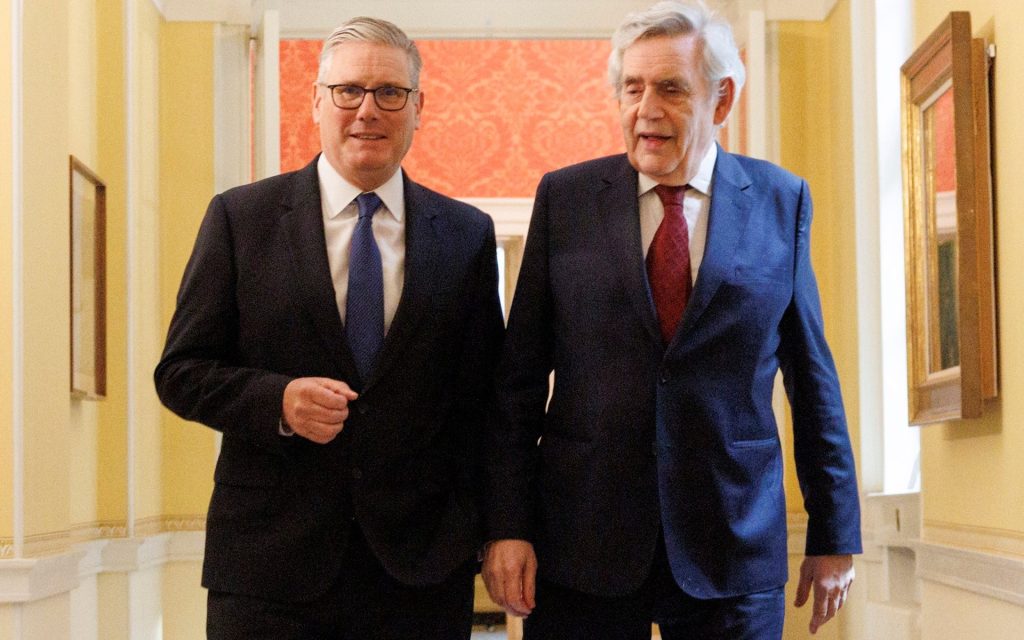
In a desperate bid to shore up his crumbling authority, Sir Keir Starmer has reached back into the party’s history books. He has appointed former Prime Minister Gordon Brown as a Special Envoy on Global Finance and Baroness Harriet Harman as an adviser on tackling violence against women and girls.
The appointment of Brown is seen as an attempt to project “gravitas” and “economic competence” at a time when the Chancellor, Rachel Reeves, is under fire for rigid fiscal rules. Brown’s role will focus on securing international defense investment and navigating global financial markets ahead of the UK’s G20 presidency in 2027.
However, many backbenchers view these appointments as “moving deckchairs on the Titanic.” Alun Davies, a veteran Welsh Labour figure, dismissed the move as “pointless” and “irrelevant,” arguing that voters are not looking for figures from the past but for a vision for the future.
Internal Civil War: The Burnham vs. Streeting Dilemma
The move by Catherine West has not just threatened Starmer; it has also ignited a strategic civil war among potential successors. The most prominent name in the conversation is Andy Burnham, the Mayor of Greater Manchester. Burnham remains the most popular Labour politician in the country, but he faces a significant hurdle: he is not an MP.
Under current rules, only a sitting MP can lead the party. This has led to a frantic effort by Burnham’s allies, including Louise Haigh, to stop Catherine West from triggering a contest too early. They fear that a “snap” leadership election would lock Burnham out, potentially handing the keys to No. 10 to Wes Streeting, the Health Secretary.
Streeting, seen as the most “ready” candidate among the moderates, has notably declined to explicitly back Starmer to lead the party into the next General Election. His “wait and see” approach has fueled rumors that he is preparing his own bid should West succeed in forcing a contest.
The Cabinet’s Response: Loyalty vs. Reality
While the backbenches are in open revolt—with over 30 MPs publicly calling for Starmer’s resignation—the Cabinet remains a fortress of (at least outward) loyalty. Lucy Powell, the Deputy Leader, has called the idea of a leadership contest “ludicrous” during a cost-of-living crisis. Similarly, Mike Tapp, the Immigration Minister, denounced West’s ultimatum as “awful,” claiming that Reform UK is “loving” the internal turmoil.
However, the silence from other “big beasts” like Angela Rayner and Wes Streeting is deafening. The Cabinet is reportedly divided between those who believe Starmer can turn it around with a “reset” and those who believe he has become a “vote-repellent.”
Key Criticisms of Starmer’s Leadership:
Lack of Vision: Voters repeatedly claim they do not know what Starmer stands for after numerous policy U-turns.
Communication Failures: The inability to offer a “hopeful” message beyond fiscal austerity.
- Management Style: Accusations of “silencing dissent” and a “top-down” approach that has alienated local councillors.
The Grassroots Rebellion: A Party Divided
It isn’t just the MPs who are angry. An open letter signed by more than 100 Labour councillors has demanded an “orderly transition” of power. The letter highlights the “devastating” loss of talent at the local level, blaming the national leadership for making “unnecessary mistakes.”
In London, the loss of control in Lewisham and Lambeth to the Green Party has been particularly embarrassing. These are areas where Labour should be untouchable. The fact that voters are defecting to the Greens and Reform UK suggests a pincer movement that could leave Labour “slaughtered” at the next general election.
Analysis: Can Starmer Survive the Monday Deadline?
The Prime Minister is banking everything on his Monday reset speech. He has promised to set out a “clear optimistic vision” focused on opportunity for young people and national security. By bringing in Gordon Brown and Harriet Harman, he is trying to show that he can lead a “broad church” and command respect on the world stage.
However, political history is littered with leaders who promised a “reset” only to find the public had already stopped listening. As Clive Betts, the longest-serving Labour MP, noted: “The public has just stopped listening to Keir. They have made their minds up.”
The “Stalking Horse” Strategy
Catherine West’s bid may not be about her becoming Prime Minister. In Westminster tradition, a “stalking horse” is a candidate who runs to test the waters and show that the leader is vulnerable, paving the way for more serious heavyweights (like Streeting or Rayner) to enter the fray. If West gets close to the 81-MP mark, the pressure on Starmer to set a departure date will become unbearable.
Conclusion: A Turning Point for British Politics
The ultimatum issued by Catherine West marks a turning point in the 2026 political calendar. Whether she succeeds in triggering a contest or simply forces Starmer to announce a retirement timetable, the authority of the Prime Minister has been permanently diminished.
The Labour Party now faces a fundamental question: can it evolve to meet the challenges of a multi-party Britain where Reform UK and the Greens are no longer “fringe” players, or will it succumb to the same internal divisions that kept it out of power for over a decade?
Monday will not just be about Catherine West’s list of names; it will be about the very soul and future of the Labour movement. As the country watches, the Cabinet must decide if they will stand by their leader or heed the warning from Hornsey and Friern Barnet.
Frequently Asked Questions (FAQ)
1. Who is Catherine West?
Catherine West is the Labour MP for Hornsey and Friern Barnet. She served as a junior minister in the Foreign Office until 2025 and has now positioned herself as the primary challenger to Sir Keir Starmer’s leadership.
2. How many MPs are needed to trigger a Labour leadership contest?
A minimum of 81 Labour MPs (20% of the parliamentary party) must back a single challenger to trigger a formal election.
3. Why did Labour lose so many seats in the 2026 local elections?
Analysts point to a “perfect storm” of the cost-of-living crisis, dissatisfaction with Starmer’s perceived lack of vision, and a surge in support for Reform UK and the Green Party.
4. Can Andy Burnham become the next Labour leader?
Not currently. Under party rules, the leader must be a sitting Member of Parliament. Burnham is currently the Mayor of Greater Manchester and does not hold a seat in the House of Commons.
5. What is Gordon Brown’s new role?
Gordon Brown has been appointed as the Prime Minister’s Special Envoy on Global Finance, an unpaid, part-time role aimed at boosting the UK’s economic and defense security.