Resilient Skies: Emirates Group Shatters Records with AED 24.4 Billion Profit in 2025-26

The global aviation landscape is defined by volatility, yet one entity continues to defy the odds with remarkable consistency. The Emirates Group has officially released its 2025-26 Annual Report, signaling a historic milestone: a record profit before tax (PBT) of AED 24.4 billion (US$ 6.6 billion). Despite facing a significant, industry-wide disruption in the final month of the financial year, the Dubai-based aviation giant has cemented its status as the world’s most profitable airline for the 2025-26 reporting period.
This performance is not merely a statistical success; it is a testament to the resilience of the Emirates business model. With revenue climbing to an unprecedented AED 150.5 billion (US$ 41.0 billion), the Group has proven that strategic investment, a focus on premium customer experience, and a robust, diversified portfolio are the ultimate safeguards against geopolitical and operational headwinds.
Financial Highlights: A Year of Unprecedented Growth
The 2025-26 financial year, ending 31 March 2026, saw the Emirates Group achieve growth across every major metric. Even with the adoption of Pillar Two tax rules—which increased the UAE corporate tax rate to 15%—the Group’s bottom line remained strong.
The Power of the Emirates Airline
Emirates airline remains the crown jewel of the Group, contributing a record PBT of AED 22.8 billion (US$ 6.2 billion). This represents a 7% increase over the previous year. The airline’s ability to maintain a PBT margin of 17.4% while scaling its fleet is a masterclass in operational efficiency.
Record Revenue: AED 130.9 billion (US$ 35.7 billion), up 2%.
Cash Assets: A record-breaking AED 54.9 billion (US$ 15.0 billion), providing a massive buffer for future expansion.
Operational Excellence: An EBITDA of AED 41.1 billion across the Group showcases the sheer scale of the airline’s profitability.
dnata’s Steady Contribution
While the airline grabs headlines, dnata continues to be the backbone of global airport operations. Reporting a record revenue of AED 23.6 billion (US$ 6.4 billion), dnata saw a 12% jump in its top line. Its ability to provide seamless ground handling, catering, and travel services across international markets—including Australia, the UK, and the US—solidifies the Group’s integrated strength.
Navigating the February 2026 Disruption
The 2025-26 financial year was not without its trials. In late February 2026, military activity in the Gulf region caused massive, unprecedented disruptions to commercial air traffic. For many carriers, such an event would spell disaster. For the Emirates Group, it was a moment to demonstrate agility.
His Highness Sheikh Ahmed bin Saeed Al Maktoum, Chairman and Chief Executive, noted that the first 11 months of the year were stellar, significantly outperforming targets. When the disruption hit, the Group’s aviation ecosystem—backed by years of infrastructure investment—allowed the UAE government to secure safe corridors for commercial flights rapidly.
While passenger capacity was temporarily reduced, the Group’s focus remained on business continuity and the safety of its people and customers. This “bounce back” mentality has been a hallmark of the Emirates strategy for decades, ensuring that even when the skies turn turbulent, the business remains on a steady trajectory.
Strategic Investments and Future-Proofing
The Group is not resting on its laurels. In 2025-26, the company invested a staggering AED 17.9 billion (US$ 4.9 billion) into new aircraft, cutting-edge technology, and infrastructure. These investments are designed to ensure long-term dominance in the global travel market.
Fleet Expansion and Modernization
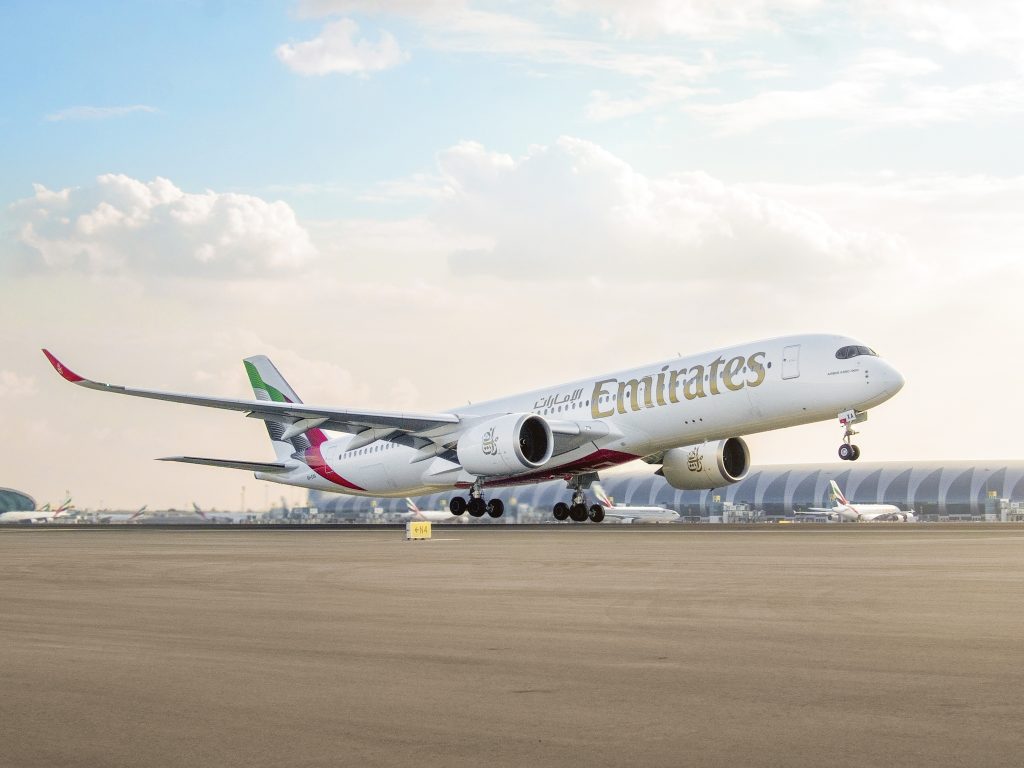
The arrival of 15 new Airbus A350 aircraft this year has been a game-changer, allowing Emirates to introduce its latest cabin products, including the highly sought-after Premium Economy class. With 19 A350s now in the fleet, the airline is offering a superior product to passengers flying to 21 destinations.
The order book remains robust, with 367 aircraft scheduled for delivery through 2038, including the Boeing 777-9 and 787s. This ensures that Emirates will continue to command the most modern, fuel-efficient, and comfortable fleet in the sky.
Connectivity and Technology
Emirates is bridging the gap between air and ground with high-speed Starlink Wi-Fi. By the end of the fiscal year, 21 aircraft were already equipped with this technology, offering passengers a “best-in-sky” experience. Furthermore, the US$ 5.0 billion retrofit programme is moving at pace, with 91 aircraft already boasting refreshed cabins.
Sustainability and Community Focus
Growth at the Emirates Group is increasingly defined by its commitment to sustainability and social responsibility. The Group is not just looking at profit; it is looking at its footprint.
Sustainable Aviation Fuel (SAF): Emirates is actively exploring SAF supplies at Dubai airports via an MoU with ENOC Group.
Waste Management: Emirates Flight Catering has commissioned large-scale biodigesters, while dnata is actively reducing food waste through partnerships like Reloop.
Human Capital: The workforce grew by 8% to over 130,000 employees. Notably, the UAE national workforce has surpassed 4,000, underscoring the Group’s commitment to local talent development.
The Path Ahead: 2026-27 and Beyond
As the world enters the 2026-27 financial year, the outlook for Emirates remains one of cautious optimism. While military activities in the region have seen a pause under a ceasefire, the Group is preparing for all scenarios.
“From a fuel perspective, Emirates is well-hedged until 2028-29,” says Sheikh Ahmed. This forward-thinking financial strategy, combined with a record cash balance, gives the Group the freedom to continue its aggressive growth plans without needing to resort to “knee-jerk” cost-cutting measures.
Why Emirates Will Continue to Lead
- Strategic Location: Dubai remains the nexus of global trade, travel, and commerce.
- Financial Stability: With massive cash reserves, the Group can weather virtually any geopolitical storm.
- Customer-Centric Innovation: Whether it is the new “Accessible and Inclusive Travel Hub” or the expansion of the Skywards loyalty programme, the passenger experience remains the priority.
- Operational Agility: The ability to pivot during the February 2026 disruption proves that the management team can handle crisis with grace and speed.
Conclusion
The Emirates Group’s 2025-26 performance is a masterclass in corporate resilience. Reporting a record profit of AED 24.4 billion is a massive achievement, but doing so while navigating a complex geopolitical climate is what truly sets the company apart. By focusing on its people, investing in the latest aircraft, and maintaining a steadfast commitment to the Dubai hub, the Emirates Group has secured its position as the undisputed leader of the global aviation industry.
As we look toward the future, the message from the Group is clear: their fundamentals are strong, their ambition is unchanged, and their commitment to being the “best in the world” remains their guiding light.