Marco Rubio’s Vatican Mission: Navigating the Geopolitical Rift Between Pope Leo XIV and President Trump

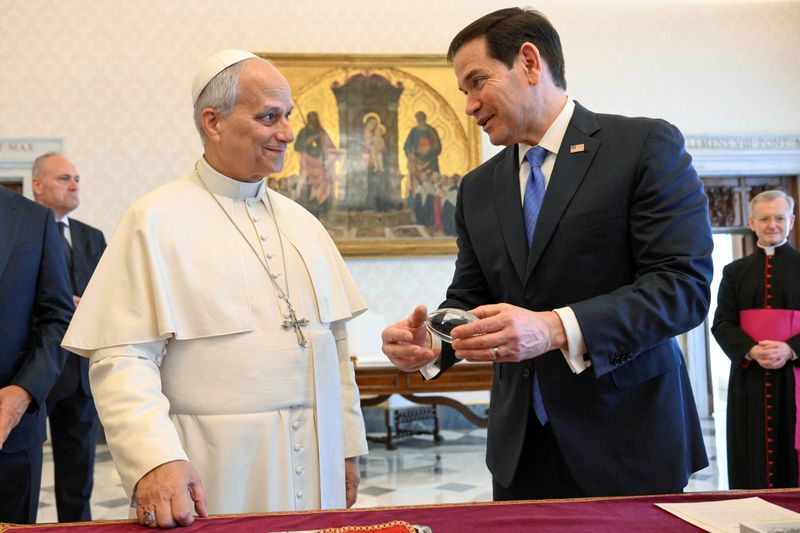
The cobblestone streets of Vatican City witnessed a moment of intense diplomatic theater on Thursday, May 7, 2026. U.S. Secretary of State Marco Rubio departed the Apostolic Palace after a grueling, two-and-a-half-hour meeting with Pope Leo XIV, marking a pivotal moment in what has become the most strained period of U.S.-Vatican relations in modern history.
As the sun caught the tinted windows of Rubio’s high-security convoy, the silence from both the State Department and the Holy See spoke volumes. This wasn’t a standard diplomatic courtesy call; it was a high-stakes attempt to bridge a widening chasm between an administration locked in a controversial conflict in the Middle East and a Pontiff who has made peace his primary mandate.
The First American Pope vs. The Trump Administration
To understand the weight of this meeting, one must look at the unique dynamics of 2026. Pope Leo XIV, the first-ever American-born Pope, has spent his first year in office (which he celebrates this Friday) becoming a formidable moral voice on the world stage. His elevation was initially seen by some in Washington as a potential bridge-builder, but the reality has been far more complex.
The tension centers on President Donald Trump’s aggressive foreign policy, specifically the U.S.-Israeli war on Iran. Pope Leo has not minced words, labeling the conflict a humanitarian catastrophe and a failure of global leadership. In response, President Trump has launched an unprecedented series of public attacks against the Catholic leader, even suggesting that the Pope’s opposition to the war somehow equated to supporting Iran’s nuclear ambitions—a claim the Vatican has vehemently denied.
Inside the 150-Minute Meeting: What Was Discussed?
While official transcripts are non-existent, the duration of the meeting tells its own story. Originally scheduled as a shorter encounter, the dialogue between Rubio and Leo ran significantly over time. In fact, the Pope arrived 40 minutes late for his subsequent appointment with Vatican staffers, an unusual breach of protocol for which he reportedly thanked them for their patience.
A “Frank” Conversation on Global Security
U.S. Ambassador to the Holy See, Brian Burch, had predicted a “frank” conversation, and all signs suggest that Rubio was met with the Pope’s unwavering stance on peace. Rubio, a devout Catholic himself, found himself in the difficult position of representing an administration that the Pope recently suggested was part of a “handful of tyrants” ravaging the world.
The Iran War and Nuclear Ethics
The core of the “fraught” atmosphere is the Iran war. President Trump’s rhetoric reached a fever pitch earlier this week when he falsely claimed the Pope believed it was “okay” for Iran to obtain nuclear weapons.
In a rare direct rebuttal, Pope Leo told journalists that the mission of the Church is to preach the Gospel and peace. He reiterated that the Catholic Church considers all nuclear arms to be immoral, a doctrine that has been consistent for decades but takes on new urgency in the 2026 geopolitical climate.
Geopolitical Friction: Beyond the Middle East
While the Iran war dominated the headlines, Rubio’s agenda was broader. Before arriving in Rome, Rubio indicated that he intended to discuss:
Religious freedom in authoritarian regimes.
The deteriorating situation in Cuba.
- The Trump administration’s hardline anti-immigration policies, which the Pope has criticized as a violation of human dignity.
The inclusion of Cuba is particularly notable given Rubio’s personal history and the Vatican’s long-standing role as a mediator between Washington and Havana. However, with the current “feud” between the White House and the Vatican, any collaborative effort on Caribbean policy seems stalled.
The Domestic Political Stakes for the GOP
The timing of this meeting is critical for the domestic landscape in the United States. Catholics remain the largest religious voting bloc in America, and the public spat between a Republican President and the first American Pope has created a political minefield.
Both Secretary Rubio and Vice President JD Vance are practicing Catholics. Their presence in the administration was once seen as a way to solidify the Catholic vote. However, the “unprecedented attacks” by Trump have drawn a backlash from Christian leaders across the political spectrum, leaving Rubio to act as a “theological diplomat” trying to prevent a mass exodus of Catholic voters ahead of the midterms.
The International Chorus: Tusk and Meloni
Rubio wasn’t the only world leader at the Vatican on Thursday. As he arrived, Polish Prime Minister Donald Tusk was departing. Tusk’s comments to the press offered a sharp contrast to the Washington-Vatican friction. He spoke of “strengthening international cooperation” and “generating hope,” warning that the world need not “descend into chaos” if people of goodwill unite.
Furthermore, Rubio’s itinerary includes a meeting with Italian Prime Minister Giorgia Meloni on Friday. Meloni has emerged as an unexpected defender of the Pope, despite her own right-wing leanings. Her defense minister has gone as far as to say that the war in Iran is actively endangering U.S. global leadership, signaling that even America’s closest European allies are increasingly aligned with the Vatican’s calls for de-escalation.
Analysis: Why Rubio Traveled Without the Press
One of the most unusual aspects of this trip was Rubio’s arrival in Rome. Typically, the U.S. Secretary of State travels with a “press pool”—a group of journalists who document every move. This time, Rubio arrived without any accompanying media on his plane.
This move suggests a desire for “quiet diplomacy.” The administration likely wanted to avoid the optics of a media circus during such a sensitive meeting. By keeping the press at arm’s length, Rubio may have hoped to speak more freely with the Pope and Cardinal Pietro Parolin, the Vatican’s top diplomat, without the immediate pressure of soundbites.
The Moral Authority of Pope Leo XIV in 2026
Marking his first anniversary this week, Pope Leo XIV has proven to be more than just a figurehead. His willingness to stand up to the leader of his home country has bolstered his standing in the Global South and among European leaders who are wary of the Trump administration’s “America First” unilateralism.
During his recent four-nation African tour, Leo decried the “tyranny” of global leadership. While he later clarified he wasn’t aiming specifically at Trump, the message was received loud and clear in Washington. The Pope is positioning the Holy See as the ultimate “soft power” check on military aggression in 2026.
Conclusion: A Deepening Divide or a Path to Peace?
As Marco Rubio leaves Rome for his meeting with PM Meloni, the world is left to wonder if any ground was gained during those 150 minutes in the Apostolic Palace. The lack of a joint statement suggests that the fundamental disagreements over the Iran war and immigration remain unresolved.
However, the fact that the meeting lasted longer than planned indicates a level of engagement that transcends simple political theater. Whether Rubio can convince President Trump to tone down his rhetoric—or whether Pope Leo XIV will continue to use his pulpit to challenge the White House—will define the moral and political landscape of the coming year.
In 2026, the road to global peace seems to run directly through the Vatican, but as long as the “war of words” between the President and the Pope continues, that road remains fraught with peril.
Key Takeaways from the Rubio-Vatican Visit:
- Extended Dialogue: The 2.5-hour meeting suggests a deep dive into contentious issues like the Iran war and Cuba.
- Unprecedented Tension: The first American Pope is in a direct rhetorical battle with the U.S. President.
- Catholic Voting Bloc: Rubio’s mission has significant domestic implications for the GOP’s relationship with Catholic voters.
- Allied Misalignment: European leaders like Tusk and Meloni appear more aligned with the Vatican’s peace-first approach than with Washington’s current military strategy.