Divine Diplomacy: Inside Marco Rubio’s High-Stakes Mission to Heal the Vatican-Washington Rift

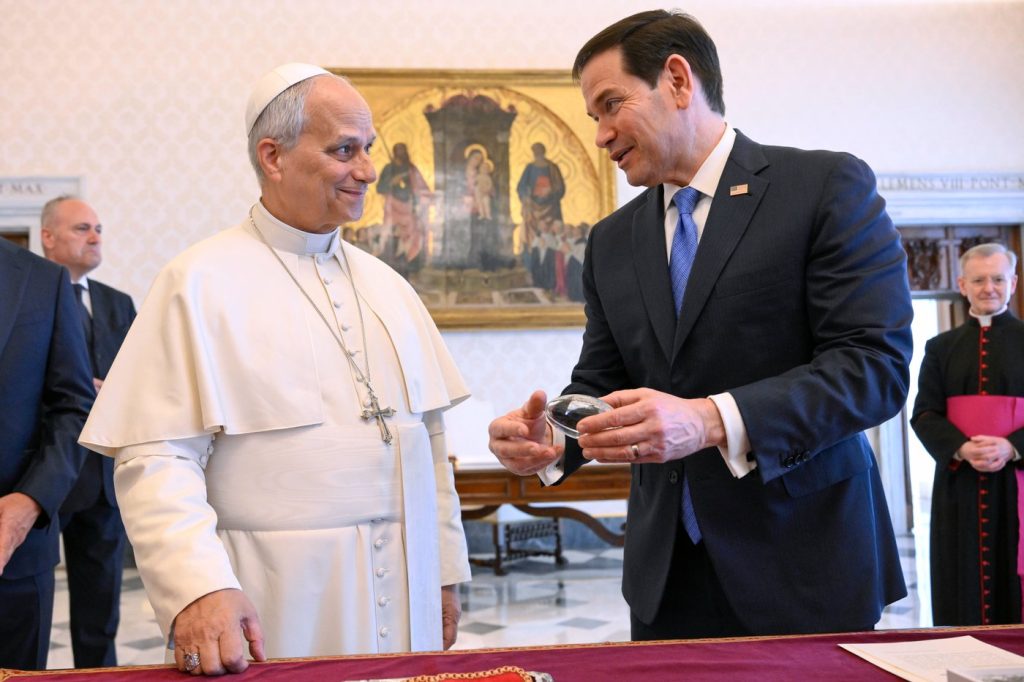
The halls of the Apostolic Palace are accustomed to the quiet whispers of centuries-old tradition, but on Thursday, May 7, 2026, they echoed with the weight of modern geopolitical friction. U.S. Secretary of State Marco Rubio arrived in Vatican City not just as a diplomat, but as a bridge-builder tasked with a formidable challenge: mending a fractured relationship between President Donald Trump and Pope Leo XIV.
This “fence-mending” visit comes at a critical juncture in global history. With the U.S.-Israeli war against Iran casting a long shadow over international relations, the rhetoric coming out of Washington has frequently clashed with the Holy See’s traditional role as a mediator for peace. As Rubio navigated the ornate corridors of the Vatican, the world watched to see if a practicing Catholic Secretary of State could reconcile the “America First” doctrine with the universal moral imperatives of the Church.
A Collision of Worldviews: Why the Tension Escalated
The friction between the White House and the Holy See is not merely a matter of personality; it is a fundamental disagreement over the ethics of modern warfare and migration. President Trump’s recent broadsides against Pope Leo XIV—the Chicago-born pontiff known for his plain-spoken advocacy for the marginalized—have pushed bilateral ties to their lowest point in decades.
The Iran War and the “Just War” Debate
The primary catalyst for the current strain is the ongoing conflict in the Middle East. While the Trump administration has framed the U.S.-Israeli war in Iran as a necessary strike against nuclear proliferation and terrorism, Pope Leo XIV has been a vocal critic. The Pope has repeatedly called for an immediate ceasefire and dialogue, famously stating that “God does not listen to the prayers of those who wage war.”
Trump’s response was characteristically blunt. On social media, the President accused the Pope of being “soft on crime and terrorism” and suggested that Leo XIV was “OK” with Iran obtaining nuclear weapons. These comments ignored the Vatican’s long-standing opposition to all nuclear armaments, a position Leo XIV felt compelled to reiterate just days before Rubio’s arrival.
The Social Media Firestorm
Compounding the policy disagreements was a bizarre social media incident in which President Trump shared an image appearing to liken himself to Jesus Christ. Although the post was quickly deleted following a global backlash, the damage was done. When asked for an apology, the President instead claimed the image represented him as a “doctor” healing the nation. This exchange set a tense stage for Rubio’s diplomatic mission.
The 150-Minute Audience: What Happened Behind Closed Doors?
Marco Rubio’s visit began with a private audience with Pope Leo XIV, followed by a lengthy meeting with the Vatican’s Secretary of State, Cardinal Pietro Parolin. For two and a half hours, the officials engaged in what was described as a “frank and cordial” exchange of views.
Reaffirming Bilateral Ties
Despite the public vitriol from Washington, the official statements following the meeting were carefully calibrated to project stability. Both the U.S. State Department and the Holy See emphasized their shared commitment to fostering good bilateral relations.
The discussion reportedly focused on:
Humanitarian efforts in the Western Hemisphere.
The pursuit of a durable peace in the Middle East.
The promotion of religious freedom as a cornerstone of global stability.
The Role of Cardinal Pietro Parolin
Cardinal Parolin, the Vatican’s top diplomat, did not mince words leading up to the visit. He had previously described Trump’s attacks on the Pope as “strange, to say the least.” During the meeting, Parolin reportedly defended the Pope’s right to advocate for peace without being characterized as a political partisan. Rubio, for his part, sought to frame Trump’s concerns as being rooted in the protection of Christians worldwide from the threat of a nuclear Iran.
Gifts and Symbolism: A “Semantic Corrective”
In diplomacy, symbols often speak louder than communiqués. The exchange of gifts between Rubio and Leo XIV provided a glimpse into the attempts to humanize a relationship that has become overly politicized.
The Crystal Football: Rubio presented the Pope with a crystal football paperweight bearing the seal of the State Department. Acknowledging the Pope’s well-known love for the Chicago White Sox, Rubio joked about the difficulty of finding a gift for a man who has everything.
- The Olive Wood Pen: The Pope responded with a pen made of olive wood—the universal symbol of peace—engraved with his coat of arms. He also gifted Rubio a book of Vatican artworks, a reminder of the Church’s enduring cultural and spiritual legacy.
The Rev. Antonio Spadaro, a close advisor to the Vatican, noted that Rubio’s mission was a “semantic corrective.” It was an implicit acknowledgment by Washington that the Pope’s voice carries a global weight that cannot be dismissed by social media posts alone.
The Cuba Agenda: Rubio’s Personal Stakes
While the Iran war dominated the headlines, Rubio also brought a specific regional focus to the table: Cuba. As the son of Cuban immigrants and a known hawk on Caribbean policy, Rubio used the Vatican’s influence to discuss the deteriorating situation in Havana.
Humanitarian Aid and Political Instability
Following the ouster of Venezuelan President Nicolás Maduro in early 2026, the Trump administration has turned its gaze toward Cuba. Rubio revealed that the U.S. had provided $6 million in humanitarian aid to Cuba, but the current regime has blocked its distribution.
The U.S. is now looking to the Catholic Church—a powerful institution within Cuba—to facilitate the delivery of aid. However, the shadow of potential military action looms large. Trump has suggested that naval assets currently in the Middle East could be redirected toward Cuba, a prospect that deeply concerns the Vatican, which favors diplomatic transitions over military interventions.
European Allies and the “Illegal War” Narrative
Rubio’s Rome itinerary extends beyond the Vatican. On Friday, he is scheduled to meet with Italian Premier Giorgia Meloni and Foreign Minister Antonio Tajani. These meetings are expected to be equally challenging.
The Rift with NATO
Meloni, once a staunch ally of the Trump administration’s conservative agenda, has broken ranks over the Iran war. Like the Pope, she has defended the legality of international norms and criticized the war as “illegal.” This stance has drawn the ire of President Trump, who recently announced plans to withdraw thousands of American troops from Germany as a punitive measure against NATO allies who do not support his military strategy.
Rubio as the Conciliator
Analysts are divided on whether Rubio is acting solely on behalf of the President or if he is carving out his own path. Giampiero Gramaglia, a seasoned diplomatic commentator, suggests that Rubio’s mission might be more about his own 2028 presidential ambitions. By positioning himself as the adult in the room who can talk to both a populist President and a moral authority like the Pope, Rubio is building a unique political profile ahead of the 2026 midterm elections.
The Strategic Importance of the Holy See in 2026
Why does the U.S. State Department put so much effort into “fence-mending” with a tiny city-state? The answer lies in the soft power of the Holy See.
- Global Reach: The Catholic Church has an unparalleled diplomatic network, with nuncios (ambassadors) in almost every country.
- Moral Authority: In times of war, the Pope’s voice resonates with over 1.3 billion Catholics and millions of others who look to him for moral guidance.
- Conflict Resolution: The Vatican has a history of successful mediation, from the Beagle Channel dispute to the normalization of U.S.-Cuba relations under the Obama administration.
For the Trump administration, alienating the Vatican means losing a vital channel of communication in regions where the U.S. military cannot—or should not—go.
Analysis: Can the Relationship Be Saved?
The success of Rubio’s visit will not be measured by the gifts exchanged, but by the rhetoric that follows. If President Trump continues his digital attacks on Pope Leo XIV, the “fence-mending” will be seen as a hollow exercise. However, if the administration begins to use the Vatican as a partner for humanitarian aid in Cuba and Venezuela, it could signal a pivot toward a more nuanced foreign policy.
The “Leo XIV” Factor
Pope Leo XIV is not a pontiff who shies away from conflict. His background as a Chicago native gives him a unique understanding of American political culture, making him less likely to be intimidated by Washington’s pressure tactics. His insistence that the Church must “preach the Gospel and preach peace” remains an immovable object against the “America First” irresistible force.
Conclusion: A Fragile Rapprochement
As Marco Rubio departs Rome, the official narrative is one of “solid ties” and “shared commitments.” Yet, beneath the diplomatic veneer, the tensions remain palpable. The Vatican-U.S. relationship in 2026 is a microcosm of a larger global struggle: the clash between populist nationalism and traditional internationalism.
Rubio has successfully lowered the temperature, but the fire of the Iran war still burns. Whether the “olive wood pen” of peace can outlast the “crystal football” of state power remains to be seen. For now, the world can take a brief breath of relief that the two most influential voices in the West are at least talking again.