London’s Political Earthquake: Labour Under Siege as Greens and Reform Surge in 2026 Polls

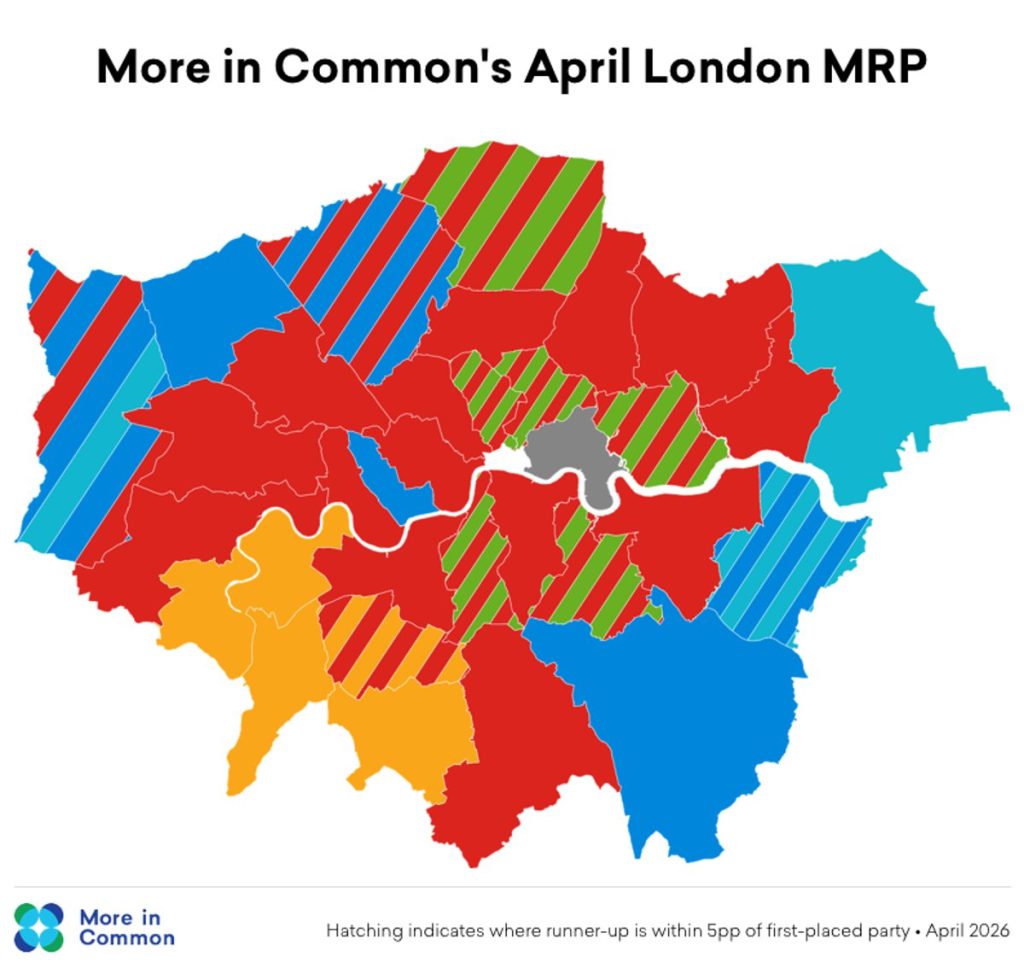
The political landscape of London is undergoing a seismic shift that few predicted just two years ago. As the capital approaches the pivotal May 2026 local elections, a fresh MRP poll from More in Common paints a picture of a city in flux. Sir Keir Starmer’s Labour Party, long the undisputed hegemon of London politics, finds itself “under siege,” facing a dual-pronged assault from a surging Green Party and an increasingly potent Reform UK.
While Labour remains the largest party in 21 boroughs, the margins of their dominance have evaporated. With a 15-point slump in support since the 2024 general election, the Labour brand is struggling to maintain its grip on traditional heartlands. As voters prepare to head to the polls, the “five-party politics” era has arrived, turning previously safe wards into unpredictable battlegrounds.
The Green Surge: Zack Polanski’s Challenge to Labour Hegemony
The most striking narrative of the 2026 election cycle is the rise of the Green Party under the leadership of Zack Polanski. For decades, areas like Hackney, Lambeth, and Lewisham were considered impenetrable Labour fortresses. Today, those walls are crumbling.
The More in Common data reveals that the Greens have overtaken Labour in Hackney, commanding 34% of the vote compared to Labour’s 31%. This isn’t an isolated anomaly; the party is within two percentage points of Labour in Lewisham, Lambeth, and Islington.
Why Urban Progressives are Jumping Ship
The Green surge is driven by a combination of disillusionment with the current government and a desire for more radical environmental and social policies. Urban progressives, who feel Labour has drifted toward the center, are flocking to the Greens as a more authentic alternative.
Policy Alignment: Voters are prioritizing climate action and housing reform.
Tactical Shifts: In many wards, the Greens are now the primary challengers, forcing Labour to defend territory they once took for granted.
- The “Polanski Effect”: Zack Polanski’s strategic focus on inner-London boroughs has successfully mobilized voters who previously felt politically homeless.
Starmer’s Labour: A Party at a Crossroads
Sir Keir Starmer’s government faces a harsh reality check in London. Once the “crown jewel” of Labour’s electoral map, the capital is now reflecting a broader national trend of fragmentation. With Labour’s vote share dropping to 28%—a decline of 15 points—the party is no longer hitting the 40% threshold that historically guaranteed them success in 21 councils.
The challenge is not just from the left. As Labour loses ground in the inner city, they are also struggling to hold onto voters in the outer boroughs against a resurgent Reform UK. This “pincer movement” leaves the party fighting on multiple fronts, with senior Labour figures warning that the government must stop taking its progressive base for granted if it wishes to avoid a “political earthquake” in May.
The Reform Factor: Disrupting the Outer Boroughs
While the Greens dominate the headlines in inner London, Reform UK is quietly orchestrating its own revolution in the outer boroughs. The party, led by Nigel Farage, is making significant inroads into areas that were once considered safe Conservative territory.
In Havering, Reform is on track for a historic win, with Farage himself confident that the borough will fall to his party. Meanwhile, in Bexley, the battle between the Conservatives and Reform is razor-thin, with the two parties sitting at 31% and 30% respectively. This fragmentation of the right-wing vote is creating a complex electoral map where small margins will dictate the outcome of dozens of council seats.
The Conservative Struggle for Relevance
Kemi Badenoch’s Conservative Party is fighting for its survival in the capital. Despite hopes of reclaiming “crown jewel” councils like Westminster, Wandsworth, and Barnet, the polling suggests a different story. The Tories are currently trailing Labour in all three of these key areas and are leading in only five outer-London boroughs.
The Conservative strategy of winning back disillusioned voters is being hampered by the surge of Reform UK, which is effectively splitting the right-wing vote. As the party struggles to differentiate itself, the “knife-edge” nature of boroughs like Hillingdon—where Labour and the Tories are deadlocked at 26%—highlights the extreme volatility of the 2026 electorate.
The Liberal Democrat Factor
Not to be overlooked, the Liberal Democrats are also navigating this crowded field. While they remain behind Labour in key target areas like Merton, they are maintaining a consistent vote share of 14%.
The Lib Dems are banking on the fact that one-fifth of Londoners remain undecided. In a landscape where results are expected to be decided by very thin margins, the final week of campaigning will be crucial for Sir Ed Davey’s party as they attempt to peel away voters from both the Labour and Conservative camps.
Conclusion: An Unrecognizable Electoral Map
As we look toward May 7, the consensus is clear: the London electoral map of 2026 will look nothing like what we have become accustomed to. The rise of multi-party politics means that we are likely to see a surge in councils falling into “no overall control,” requiring complex coalitions and power-sharing agreements.
Whether the Green surge continues to bite into Labour’s heartlands or if Labour can stabilize its position remains the defining question of the election. One thing is certain: London’s political dominance is no longer a given. For the parties involved, the race is on, and for the voters, the stakes have never been higher.