Bunker Mentality: How Putin’s Drone Paranoia Became the Internet’s Favorite Punchline

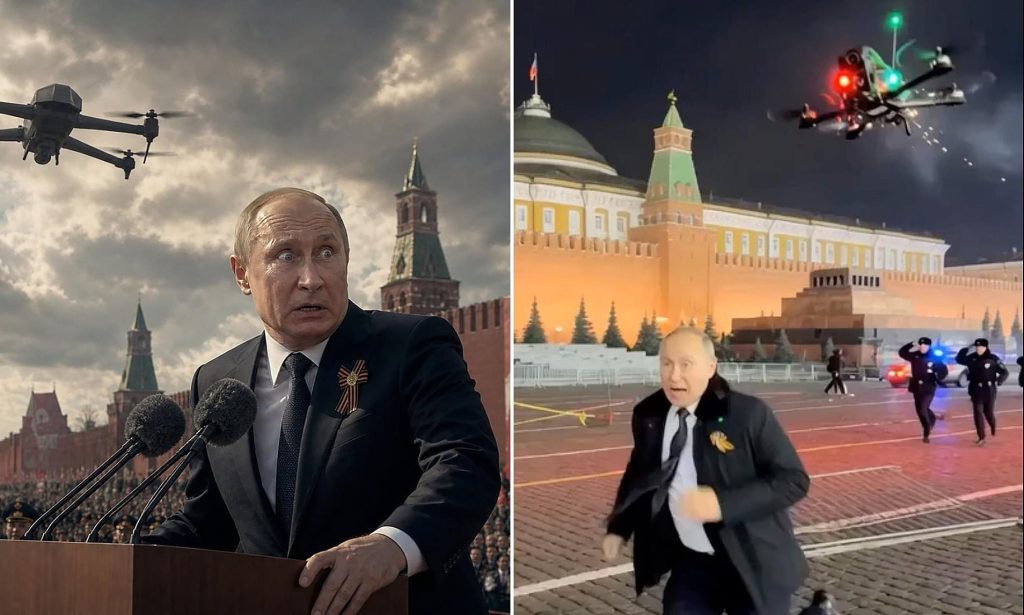
In the spring of 2026, the Kremlin’s grip on its own narrative is slipping—not just on the battlefield, but in the digital arena. As Russia approaches its annual Victory Day parade, the image of Vladimir Putin, once carefully curated as a “strongman” leader, has been dismantled by a wave of viral social media mockery. The source of this ridicule? An undeniable, palpable paranoia over Ukrainian drone attacks and a growing fear of internal betrayal.
While the Russian state attempts to project an image of military might, the reality on the ground in Moscow tells a different story. With internet blackouts, restricted movement, and a parade stripped of its heavy hardware, the Russian president has become the unintended star of a global meme revolution.
From Iron Fist to Armored Umbrella: The Memeification of a Dictator
The internet has a unique way of cutting through political theater, and 2026 is proving to be a watershed year for anti-Kremlin satire. As reports emerge of the 73-year-old leader hunkering down in fortified bunkers, social media users have responded with relentless creativity.
The memes range from the absurd to the symbolic. One widely shared image features Putin standing beneath an armour-plated umbrella, a satirical jab at his extreme security measures. Another AI-generated video depicts him being pursued by a nimble Ukrainian drone, turning his perceived omnipotence into a game of cat-and-mouse.
The Cardboard Parade: A Symbol of Resource Depletion
Perhaps the most biting critique involves the upcoming Victory Day parade in Red Square. In previous years, the event was a display of Russia’s heavy armor and missile capabilities. This year, the hardware is conspicuously absent—diverted to the front lines of a war that has drained the state’s military reserves.
Memes are now circulating showing Russian soldiers marching with tanks made of cardboard, highlighting the disconnect between the Kremlin’s propaganda and the realities of the ongoing conflict. This mockery serves to expose the fragility of the Russian military machine, suggesting that the “grand show of force” is now little more than a hollow performance.
The Siege Within: Why the Kremlin is Cutting the Cord
The paranoia isn’t merely about drones in the sky; it is about the threat of a coup from within his own inner circle. Intelligence reports from 2026 suggest that Putin is increasingly suspicious of his own political elite, including high-ranking figures like Sergei Shoigu.
To mitigate the risk of assassination attempts or coordinated uprisings, the Russian government took the drastic step of disabling mobile internet across Moscow. While official channels claimed these were “targeted outages” to disrupt drone navigation, the disruption of credit card payments, taxi services, and daily life suggests a government in a state of absolute lockdown.
Paranoia in the Palace
The security measures surrounding the Russian leader have reached unprecedented levels:
Restricted Movement: Staff, including cooks and photographers, are prohibited from using public transport.
Double Screening: Visitors to the president must undergo multiple layers of security checks.
Technological Isolation: Those working in close proximity to Putin are restricted to devices without internet access to prevent information leaks.
The “Cage” Narratives: Telegram channels have shared images of Putin mocked inside the metal cage structures typically reserved for armored vehicles, symbolizing his self-imposed imprisonment.
A Legacy Fading: The “Your Time Is Up” Sentiment
The most poignant memes are those that contrast the current state of Russia with its Soviet heritage. One viral image depicts Vladimir Lenin pulling Putin into his mausoleum, a clear, symbolic message that the current era is reaching its expiration date.
This sentiment is driven by a combination of economic decline, the faltering military campaign in Ukraine, and the death of high-ranking officials like Lieutenant General Fanil Sarvarov. These events have created an atmosphere of demoralization among the military elite, fueling rumors of a potential destabilization of the regime.
The Strategic Failure of the “Security State”
By prioritizing his personal survival over the functionality of the capital, Putin has inadvertently highlighted his vulnerability. The internet’s mockery is not just about the drones; it is about the realization that a leader who hides behind internet blackouts and metal cages is no longer the “strongman” he once claimed to be.
The reliance on the Federal Protection Service (FSO) to shield not just the president, but also members of the military high command, indicates a state that is turning inward to survive. As the world watches, the contrast between the grandiosity of the past and the paranoia of the present has become the defining image of the 2026 Victory Day season.
Conclusion
The digital mockery of Vladimir Putin serves as a barometer for the current state of affairs in Moscow. What started as a tactical concern regarding drone warfare has evolved into a full-scale crisis of confidence. Whether it is the cardboard tanks or the image of a leader locked in a cage, the memes reflect a global consensus that the Kremlin’s aura of invincibility has evaporated.
As Russia prepares for its scaled-down celebrations, the true spectacle isn’t taking place in Red Square—it is happening on the screens of millions of people worldwide who see through the veneer of security. In a modern world, the most dangerous weapon against a dictator isn’t always a missile; sometimes, it is the simple, biting truth delivered through a viral meme.