New Footage of Trump Assassination Attempt: DOJ Debunks Friendly Fire Rumors in 2026 Security Breach

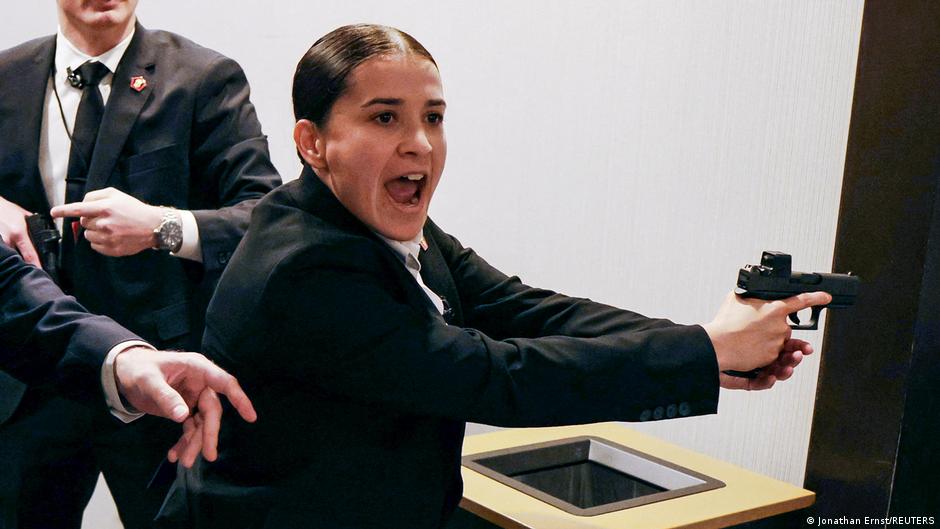
As the United States navigates a complex political landscape in 2026, the Department of Justice (DOJ) has taken a significant step toward transparency regarding one of the most harrowing security breaches in recent memory. Federal prosecutors have officially released unseen security footage of the suspect involved in the attempted assassination of President Donald Trump during the White House Correspondents’ Association (WHCD) dinner.
This release aims to quell a growing tide of public speculation and conspiracy theories suggesting that the Secret Service agent injured during the scuffle was actually a victim of “friendly fire.” By providing a visual account of the chaotic moments at the Washington Hilton, the DOJ seeks to clarify the timeline and the direct actions of the suspect, identified as 31-year-old Cole Allen.
The “Friendly Fire” Controversy: Setting the Record Straight
In the weeks following the attack, social media platforms and news outlets were rife with debates regarding the source of the bullet that struck a Secret Service officer. Public skepticism intensified when initial reports confirmed the officer was hit in his bullet-resistant vest, but failed to specify the caliber or origin of the projectile.
To address these concerns, Jeanine Pirro, the US Attorney for Washington, took the unusual step of posting the surveillance footage directly to social media. Her message was clear: “There is no evidence the shooting was the result of friendly fire.”
Official Denials from the Top
The narrative that the Secret Service mistakenly shot one of their own has been vehemently denied by multiple high-ranking officials:
President Donald Trump: Speaking from the Oval Office, the President told reporters, “They said it wasn’t friendly fire. It wasn’t us.”
Sean Curran, Secret Service Director: In a detailed interview with Fox News, Curran emphasized that the agent was shot at point-blank range by the suspect.
Jeanine Pirro: Her office maintains that the forensic evidence aligns perfectly with the suspect’s weapon being discharged during the breach.
Analyzing the Footage: Six Minutes of Chaos
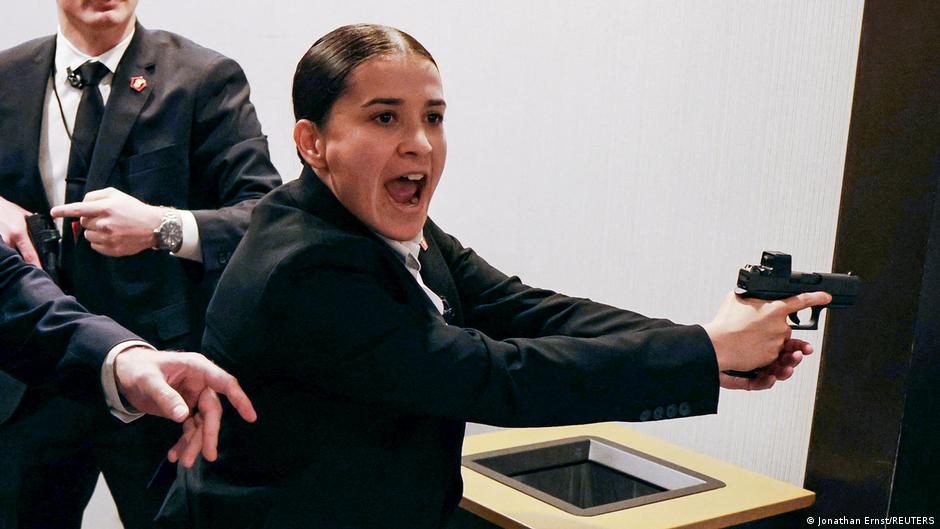
The nearly six-minute video provides a chilling look at how quickly a secure environment can turn into a combat zone. The footage begins at a security checkpoint where approximately a dozen federal officers are seen dismantling metal detectors and standing in a relatively relaxed posture.
The Breach and the Sprint
The tranquility of the scene is shattered when the suspect, Cole Allen, emerges from a doorway. Carrying a long gun, Allen begins a frantic sprint toward the security perimeter. The video highlights a significant lapse in initial awareness; most officers did not notice the gunman until he was nearly through the checkpoint.
Only one agent—the individual who was subsequently injured—had his weapon drawn before Allen reached the line. The footage captures this agent heroically engaging the suspect. According to Director Curran, this officer fired five shots in a desperate attempt to neutralize the threat as Allen attempted to storm past the security detail.
A Calculated Attack: The “Casing” Phase
Perhaps more disturbing than the attack itself is the footage showing Allen’s activities in the 24 hours leading up to the gala. The DOJ released clips of the suspect “casing the area” at the Washington Hilton hotel.
Hallway Surveillance: Allen is seen walking back and forth in the hallways, seemingly measuring distances and identifying exits.
The Hotel Gym: He briefly entered the hotel gym, possibly to check for alternative routes to the ballroom.
Strategic Proximity: Director Curran noted that the metal detectors were only 355 feet from the podium where President Trump was seated, illustrating just how close the suspect came to his target.
The Heroism of the Secret Service
While the footage reveals a moment of vulnerability at the checkpoint, it also underscores the bravery of the personnel on site. The injured agent, despite being fired upon at point-blank range, managed to return fire and prevent the suspect from reaching the inner sanctum of the dinner.
Director Curran praised the officer’s split-second decision-making. “Our officer heroically returned fire,” Curran stated, noting that the five shots fired by the agent were a necessary response to an immediate lethal threat. Interestingly, despite the exchange of gunfire, authorities confirmed that the gunman was not hit during the initial scuffle, though he was eventually tackled and detained by security guards in a “chaotic scuffle” just off-camera.
Legal Consequences for Cole Allen
As of late 2026, Cole Allen remains in federal custody. Earlier this week, he was formally charged with the attempted assassination of the US President, a charge that carries a potential sentence of life in prison.
Court Proceedings and Defense
During a recent court hearing, Allen’s attorney, Tezira Abe, stated that her client would not immediately contest the prosecutors’ arguments regarding his detention. Allen has agreed to remain in custody as the case moves forward, with the court citing him as a significant “danger to the community.”
The prosecution’s case is bolstered not only by the newly released footage but also by a concluded investigation from a US law enforcement official, reported by Reuters, which definitively ruled out friendly fire.
Security Implications for Future Presidential Events
The 2026 WHCD incident has sparked a massive review of Secret Service protocols. The fact that an armed man could sprint through a primary checkpoint with a rifle has led to calls for more advanced AI-driven surveillance and permanent physical barriers at high-profile events.
Lessons Learned from the Hilton Breach:
- Response Time: The delay in noticing the suspect highlights the need for 360-degree automated threat detection.
- Proximity Risks: The 355-foot distance to the President is now considered too narrow a margin for error in modern ballistic contexts.
- Visual Evidence: The rapid release of footage has become a tool for the government to combat “fake news” and misinformation in real-time.
Conclusion: A Nation Watching
The release of this footage serves as a sobering reminder of the persistent threats facing the nation’s leaders. By debunking the friendly fire rumors, the Justice Department hopes to focus the public’s attention on the legal process and the bravery of the agents who stand in the line of fire. As Cole Allen awaits trial, the images of his sprint through the Washington Hilton will likely remain a defining visual of the security challenges of 2026.
The transparency provided by US Attorney Jeanine Pirro and Director Sean Curran reflects a modern approach to federal investigations—where high-resolution evidence is used to uphold the integrity of law enforcement actions in the court of public opinion.