Alabama’s High-Stakes Supreme Court Appeal: The Battle to Redraw Congressional Maps

The landscape of American democracy is shifting beneath our feet as 2026 unfolds. In a move that has sent shockwaves through the legal and political communities, the state of Alabama has filed an emergency appeal with the U.S. Supreme Court. At the heart of this legal firestorm is a request to revert to a previous congressional map—one that features only a single majority-Black district—effectively challenging the court-ordered map that currently provides Black voters with two districts where they can meaningfully influence election outcomes.
This appeal arrives at a volatile moment in American jurisprudence. Following a controversial Supreme Court decision regarding Louisiana’s redistricting, which significantly weakened the scope of the landmark Voting Rights Act of 1965, Alabama officials are doubling down. They argue that the state should be permitted to implement its 2023 map, suggesting that the criteria for racial motivation in redistricting cases has reached an impossibly high threshold.
The Legal Tug-of-War: Why Alabama is Acting Now
The core of Alabama’s argument rests on the shifting interpretation of what constitutes a discriminatory map. By citing the recent precedent set in the Louisiana case, state officials are attempting to bypass federal injunctions that have held the state’s 2023 map in check.
Understanding the “Strong Inference” Standard
The Supreme Court’s recent ruling mandates that those challenging a redistricting plan must demonstrate a “strong inference” of racial motivation. Alabama’s legal team contends that their redistricting goals are rooted in “lawful policy” rather than race. However, voting rights advocates argue that this new standard creates a shield for gerrymandering, making it nearly impossible for minority communities to prove that their political voices are being systematically diluted.
The Legislative Push in Montgomery
Governor Kay Ivey has not remained on the sidelines. By signing legislation that allows for new U.S. House primaries if the courts permit a map change, the state has effectively prepared for a rapid transition. This legislative maneuvering is designed to ensure that if the Supreme Court grants their emergency request, the state can immediately implement changes before the upcoming election cycle reaches its peak.
The Supreme Court’s “Sticky Wicket”
For the Justices of the Supreme Court, this case presents a profound institutional challenge. Chief Justice John Roberts has spent recent months attempting to distance the Court from the perception that it acts as a political body. Yet, as experts like Steve Vladeck note, the Court is now being asked to intervene in a way that directly impacts the partisan balance of the U.S. House of Representatives.
A Split Decision on Precedent
The conservative majority, led by Justice Samuel Alito, faces the difficult task of reconciling their recent ruling on Louisiana with the Court’s own 2023 decision regarding Alabama. In that earlier case, the Justices had specifically rejected Alabama’s map for failing to provide adequate representation for Black voters. If the Court now allows Alabama to move forward with the very map it once questioned, it risks validating the critiques of the liberal minority, who argue that the Court is abandoning its own principles to influence election outcomes.
The Clash of Judicial Philosophies
The internal friction at the Court was on full display recently when Justice Alito and Justice Ketanji Brown Jackson traded sharp barbs. Justice Jackson accused the Court of prioritizing political outcomes over foundational legal principles, a charge Justice Alito labeled as “insulting.” This public discord highlights how deeply embedded the redistricting issue has become within the highest court in the land.
The National Context: A Southern Strategy?
Alabama’s move is not occurring in a vacuum. Across the South, Republican-led legislatures are moving with unprecedented speed to capitalize on the weakened Voting Rights Act.
Tennessee: Lawmakers have moved to carve up a Democratic-held, Black-majority district in Memphis, prompting immediate litigation.
Virginia: While Democrats saw a setback in the state supreme court regarding their own redistricting plans, the overall trend points toward a high-stakes battle for control of the U.S. House.
- The 14-Seat Goal: Political analysts suggest that if these redistricting efforts are successful, Republicans could gain upwards of 14 seats, while Democrats are fighting to maintain their influence in competitive districts.
The Impact on Alabama’s Voters
For the citizens of Alabama, this legal battle is about far more than statistics or seat counts. It is about the fundamental right to representation. When the federal court originally mandated a second district where Black voters could choose a candidate of their choice, it led to the 2024 election of Rep. Shomari Figures.
Voices from the Front Lines
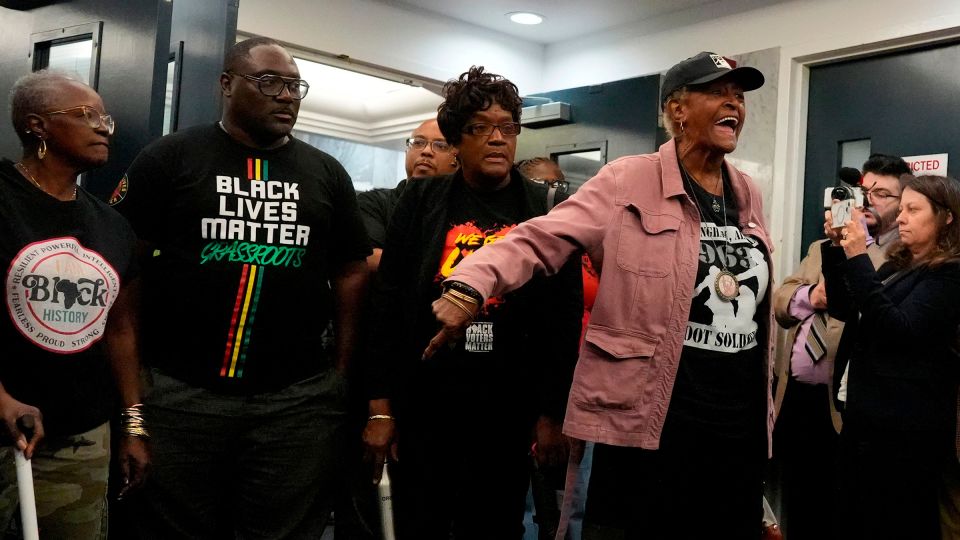
Advocates like Betty White Boynton, who participated in the historic 1965 voting rights marches, have expressed deep frustration. The sentiment on the ground is that the progress made over the last six decades is being systematically dismantled. Demonstrators outside the Alabama State Capitol have made their position clear, calling for the protection of democracy and the preservation of voting rights for all citizens.
The Legislative Response
State Senator Greg Albritton has emphasized that the special primary legislation is contingent upon court approval. “Should there be no court order issued, then this bill would have no effect,” Albritton stated. This underscores the reality that the future of Alabama’s congressional map is entirely in the hands of the U.S. Supreme Court.
Potential Outcomes and Future Implications
As the May 14 deadline for a decision approaches, the nation watches with bated breath. There are three primary ways this could unfold:
- The Court Grants the Appeal: If the Supreme Court allows Alabama to use its 2023 map, we can expect a wave of similar requests from other states, potentially shifting the legislative map significantly before the November elections.
- The Court Denies the Appeal: If the Justices refuse to lift the injunction, it would reaffirm the importance of the 2023 court-drawn map, providing a temporary victory for civil rights groups and maintaining the current level of Black representation in Alabama.
- A Narrow, Procedural Ruling: The Court could choose to delay or issue a narrow ruling that avoids the broader constitutional questions, keeping the current map in place for this cycle while leaving the long-term legal battle unresolved.
Analysis: The Erosion of Voting Rights?
The core question at stake is whether the U.S. Supreme Court is prioritizing a narrow, technical interpretation of the Voting Rights Act over the spirit of the law. By increasing the burden of proof for plaintiffs, the Court is effectively narrowing the window for addressing systemic discrimination in redistricting.
If Alabama succeeds, it will signal a new era of “legalized gerrymandering” where the focus shifts from ensuring fair representation to maximizing partisan advantage under the guise of “lawful policy goals.” The challenge for the Court is to prove that it remains an impartial arbiter of the law, rather than a participant in the political realignment of the United States.
Conclusion
The situation in Alabama is a bellwether for the future of American elections. As the Supreme Court weighs this emergency appeal, the decision will reverberate far beyond the borders of a single state. Whether or not the Court allows Alabama to redraw its districts, the legal and political ramifications will define the 2026 election cycle and beyond.
As citizens, the importance of staying informed on these judicial developments cannot be overstated. The balance of power in Congress, the integrity of our voting systems, and the promise of equal representation are all on the line. We are witnessing a pivotal moment in the American experiment, where the interpretation of our highest laws will determine the shape of our representative democracy for years to come.