“News Will Be the Star”: How Ted Turner’s Audacious Gamble Transformed Global Media

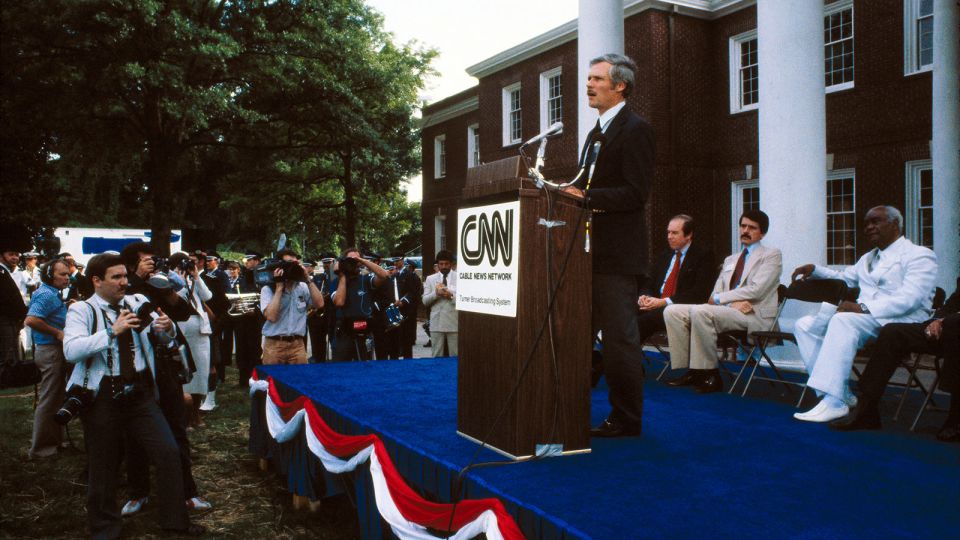
In the landscape of modern media, it is difficult to imagine a world where news isn’t available at the tap of a screen. Yet, in the late 1970s, the concept of a 24-hour news cycle was not just revolutionary—it was considered professional suicide. When Ted Turner, the eccentric billboard mogul turned broadcaster, announced his plan to launch the Cable News Network (CNN), the industry giants at ABC, NBC, and CBS didn’t just disagree; they laughed.
The skepticism was palpable. Critics labeled his ambitious project “Chicken Noodle News,” convinced that no viewer would ever care to watch news at 2:00 p.m., let alone 2:00 a.m. However, Turner possessed a rare combination of grit, foresight, and a profound disregard for market research. He didn’t just want to compete with the networks; he wanted to dismantle their monopoly on information.
The Maverick’s Vision: Disrupting the Three-Channel Environment
Ted Turner was never a man content with the status quo. After taking over his father’s billboard company and successfully pivoting into television, he developed a disdain for the “smug and self-satisfied” broadcast executives who controlled the airwaves. In their world, news was a “clunker”—a mandatory public service that was allotted a mere thirty minutes of airtime per day.
Turner’s genius lay in his belief that if he built the supply, the demand would follow. He viewed the television marketplace as a stagnant pond, ripe for disruption. By 1978, he had begun recruiting a team, including founding president Reese Schonfeld, to build a network that could survive in a cable-first world—a technology that was still in its infancy.
The Financial High-Wire Act
Launching a global network required more than just vision; it required immense capital. Turner risked his personal fortune, often staying just one step ahead of the bankers. He faced constant rejection from investors who saw his plan as a fool’s errand. Yet, Turner pressed on, driven by an almost messianic belief that news should be the “star” of the show, rather than a secondary feature of a broadcast schedule.
June 1, 1980: The Day the World Changed
The launch of CNN on June 1, 1980, was a chaotic, high-stakes affair. Based out of a former country club on Techwood Drive in Atlanta, the network was arguably “closer to ‘not’ ready than ‘ready'” when the clock struck 5:00 p.m.
In a moment of characteristic dark humor, Turner had requested that an Armed Forces Band record a performance of “Nearer, My God, to Thee.” He instructed his team to keep the tape on hand, suggesting it be played in the event of a nuclear apocalypse—a sign-off that would truly be the final broadcast.
The “Technical Warts” of Early Broadcasts
The early days of CNN were defined by what Variety magazine famously called “wonderful technical warts.” From janitors wandering into the background of live shots to missing cues and minor on-air blunders, the network was raw and unfiltered. Unlike the polished, highly produced segments of the big three networks, CNN felt human.
Turner himself was a constant presence in the newsroom, often seen in his bathrobe at the “Hard News Cafe,” blurring the lines between the owner and the staff. This hands-on, maverick leadership style bonded the team together, creating a culture of shared sacrifice and excitement.
From Local Innovation to Global Behemoth
What began as a gamble to provide news to cable subscribers in the United States quickly evolved into something much larger. Turner’s realization that even world leaders—like Fidel Castro—were finding ways to watch his network served as the catalyst for CNN International.
Chipping Down the Walls of Authoritarianism
The impact of CNN reached far beyond the living rooms of Americans. By providing a constant stream of information, the network became a tool for transparency in nations where citizens had previously only seen what their authoritarian leaders wanted them to see. Christiane Amanpour, a long-time CNN anchor, noted that Turner’s vision “chipped down the walls” of state-regulated media, opening the eyes of millions to the realities of the wider world.
The “CNN Effect” and the Legacy of 1980
The legacy of Ted Turner’s uphill battle is best summarized by what scholars and historians now call the “CNN Effect.” This term describes the phenomenon where the constant, 24-hour availability of real-time news forces governments to react to global events with greater speed and transparency.
Lessons in Resilience
Turner’s journey serves as a masterclass in entrepreneurship. He didn’t rely on market studies; he relied on his gut. He didn’t wait for a perfect moment; he created the moment. His willingness to face bankruptcy to achieve a goal that many deemed “unserious” fundamentally changed how humanity consumes information.
- Ignore the Naysayers: Turner’s success was built on his refusal to listen to established industry experts who were too comfortable to innovate.
- Focus on the Mission: By keeping the focus on “news as the star,” he avoided the trap of trying to be everything to everyone, instead perfecting the 24/7 format.
- Embrace the “Uncharted Waters”: Like his hero Christopher Columbus, Turner understood that innovation requires sailing into the unknown without a map.
Looking Back from 2026: The Enduring Impact
As we look back in 2026, the landscape of media has shifted again toward digital and algorithmic curation, yet the DNA of CNN remains embedded in our culture. Ted Turner’s “crazy idea” not only birthed the 24-hour news cycle but also paved the way for the hyper-connected, real-time world we inhabit today.
He proved that when you bet on the power of information, you aren’t just building a business—you are building a bridge between cultures. While the distribution methods have evolved, the core principle remains: the world has a fundamental need to bear witness. Turner gave us that witness, and in doing so, he forever altered the trajectory of global history.
His story is a reminder that the most significant advancements are rarely the result of consensus. They are the result of one individual’s stubborn, relentless, and occasionally “wild” vision to change the world—one newscast at a time.