Banksy Strikes Again: The Mystery and Impact of the New London Statue in Waterloo Place

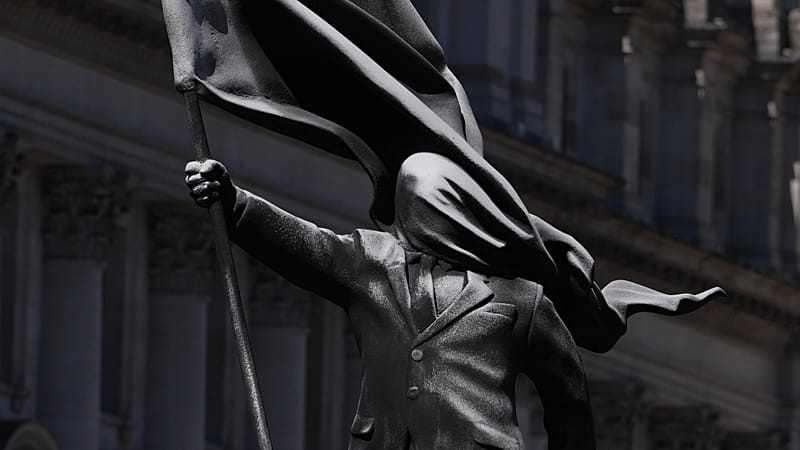
The morning of April 30, 2026, marked a significant moment in the contemporary art world as the elusive street artist Banksy officially claimed ownership of a provocative new sculpture in the heart of London. Located at Waterloo Place near Pall Mall, the installation has transformed a standard thoroughfare into a makeshift pilgrimage site for art lovers, tourists, and curious Londoners alike.
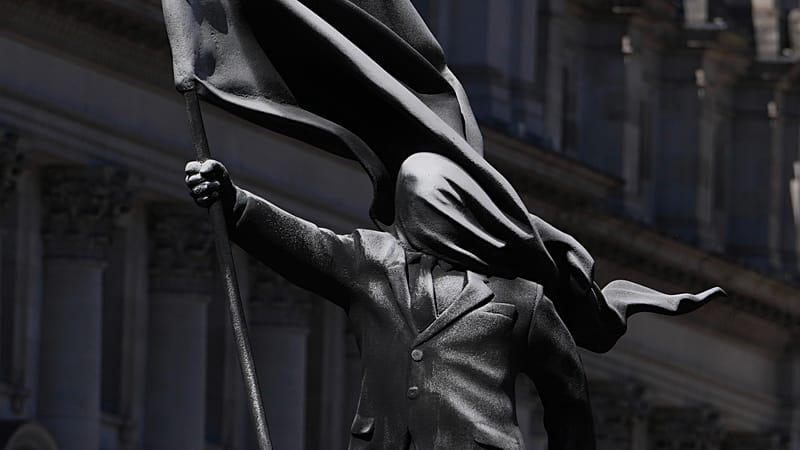
As the news broke across social media, the area quickly became a focal point of global attention. The artwork—a meticulously crafted statue of a suited man holding a large flag that completely obscures his face—has sparked intense debate regarding its political and social symbolism.
The Reveal: From Speculation to Confirmation
The statue first appeared earlier this week in the St James’s district, standing silently among the historic architecture of central London. Initially, onlookers were hesitant to label it a “Banksy,” despite the signature style and the biting satirical undertone. However, following days of online speculation and “is it or isn’t it” debates, the artist’s official channels confirmed the piece’s authenticity.
The confirmation acted as a catalyst. By midday Thursday, the quiet streets of Waterloo Place were teeming with crowds. The atmosphere was a mix of a high-end gallery opening and a public protest. To manage the influx of visitors and protect the integrity of the work, police barriers were eventually erected around the sculpture, though this has done little to deter the thousands of people queuing for a glimpse.
Analyzing the Artwork: “The Faceless Patriot”
While Banksy has not provided an official title, the public has already dubbed the piece “The Faceless Patriot” or “The Suited Standard.” The sculpture depicts a figure in a sharp business suit—a clear nod to the establishment and corporate power—stepping forward with determination.
The most striking feature is the flag. Instead of waving it proudly, the fabric is draped in a way that entirely covers the man’s head and face. This imagery suggests several layers of interpretation:
- Blind Nationalism: The idea of moving forward blindly, guided only by the symbols of state or identity.
- Loss of Individual Identity: How corporate or political roles erase the human element.
- The Hidden Face of Power: A commentary on the anonymity of those who pull the strings of society.
In the context of 2026, where global politics and digital identities are more intertwined than ever, the statue resonates deeply with a public that feels increasingly disconnected from traditional leadership.
The Digital Echo: Capturing Art in the Retina Era
In 2026, the way we consume art has shifted. While the physical statue sits in Waterloo Place, its digital footprint is massive. Visitors are not just looking; they are documenting the event with professional-grade mobile cameras capable of capturing 8K resolution and Retina-quality imagery.
The demand for high-quality visuals of the new Banksy has mirrored the popularity of other digital art trends. Just as users seek out Classic Mountain Designs or Ultra HD Ocean Images to beautify their personal devices, the “Banksy Hunt” has become a quest for the perfect, high-impact photo.
Many content creators on the scene were seen using advanced stabilization and lighting tools to ensure their shots met the strict quality standards expected by modern audiences. In a world where we are used to browsing Geometric Arts in Retina or Gradient Texture Collections in 4K, the raw, textured reality of a bronze-like statue provides a refreshing, tactile contrast.
Why Visual Quality Matters in 2026
Immersive Documentation: Fans want to see the “grit” of the statue, from the folds in the flag to the “Banksy” signature on the base.
Global Sharing: High-resolution images allow those in other parts of the world to experience the work as if they were there.
- Digital Preservation: In an era of ephemeral street art, Full HD and 4K captures are the only way to ensure the work lives on if it is eventually removed.
The “Banksy Effect” on London Tourism
London has long been a hub for street art, but a new Banksy installation brings a unique surge of economic and cultural energy. Local businesses around Pall Mall have reported a significant uptick in foot traffic. Cafes and shops are seeing “The Banksy Effect” firsthand as visitors from across the UK and overseas descend upon St James’s.
This installation follows a series of high-profile works that have appeared across London over the last year. Each piece seems to be part of a larger narrative, challenging the public to look closer at their surroundings. The use of Waterloo Place—an area known for its traditional statues of war heroes and royals—is a deliberate choice, forcing a confrontation between the “old guard” and the “new critique.”
The Intersection of Physical and Abstract Art
Interestingly, the rise of physical installations like this occurs at a time when Abstract backgrounds and Minimalist designs are dominating the digital landscape. While many people spend their days looking at Light designs or Space photos on their Desktop backgrounds, the sudden appearance of a physical, “disruptive” object in the real world creates a powerful psychological impact.
Banksy’s work often functions like a Dark Art piece—striking, slightly uncomfortable, and impossible to ignore. Much like how a Nature Pattern Collection brings a sense of organic beauty to a screen, Banksy’s statues bring a sense of organic (if uncomfortable) truth to the city streets.
Security and Longevity of the Installation
As with any Banksy piece, the question of “how long will it last?” is on everyone’s mind. The police barriers currently in place serve a dual purpose: they protect the public from the crush of the crowd and protect the artwork from potential vandalism or theft.
In the past, Banksy works have been protected by plexiglass, removed by councils, or even cut out of walls by private collectors. Given that this is a free-standing statue, the logistics of its preservation are complex. For now, the Metropolitan Police are maintaining a presence to ensure order, but the ultimate fate of the “Faceless Patriot” remains as mysterious as the artist himself.
Conclusion: A Mirror to Society
The gathering at Waterloo Place is a testament to the enduring power of art to unite and provoke. In April 2026, amidst a world of High Resolution digital distractions and 4K quality illustrations, a single physical statue has managed to stop people in their tracks.
Banksy continues to prove that he is not just a “graffiti artist” but a master of urban intervention. By placing a faceless, flag-bearing man in the heart of London’s establishment, he has held up a mirror to the passersby. Whether the statue remains for a day or a decade, the images captured today—in all their Retina-quality glory—will ensure that this message continues to circulate through the digital and physical veins of the world.
As the sun sets over central London, the crowds show no sign of thinning. The man with the flag continues his silent, blind march forward, and the world continues to watch, photograph, and wonder.