Blinded by the Flag: Banksy Claims Provocative New Statue in Central London’s Waterloo Place

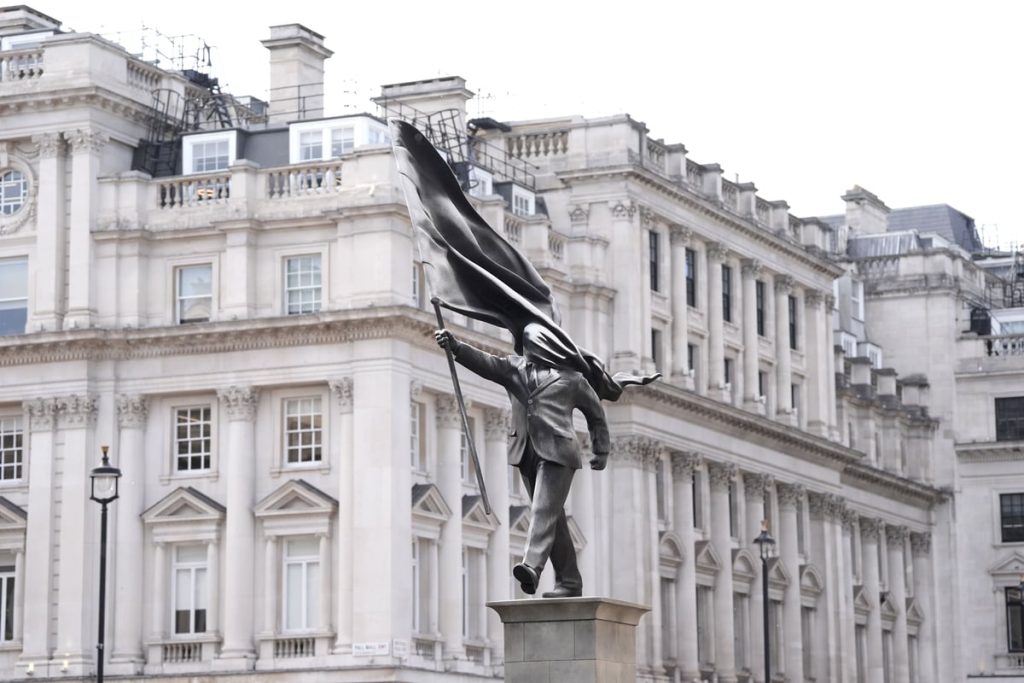
The world of contemporary art has once again been set ablaze as the elusive street artist Banksy officially claimed responsibility for a stunning new sculpture in the heart of London. Appearing seemingly out of thin air in the early hours of a Wednesday morning in 2026, the installation has already become a focal point for tourists, art critics, and political commentators alike.
Situated on a prominent traffic island in Waterloo Place, just a stone’s throw from The Mall and Buckingham Palace, the sculpture represents a bold evolution in the artist’s medium. While Banksy is globally renowned for his stencil-based murals, this large-scale 3D installation marks a sophisticated shift into the realm of public monuments.
The Reveal: A Midnight Operation in Central London
The arrival of the statue was as clandestine as one would expect from the Bristol-born enigma. According to reports and a subsequent video released on Banksy’s official Instagram account, a team utilized a lorry and a crane to haul the massive piece into position under the cover of darkness.
The artist later confirmed the work was his, simply noting that on the traffic island in Pall Mall, “there was a bit of a gap.” This characteristic wit masks the logistical complexity of the operation, which took place in one of the most heavily surveilled areas of the capital.
Visual Breakdown of the Sculpture
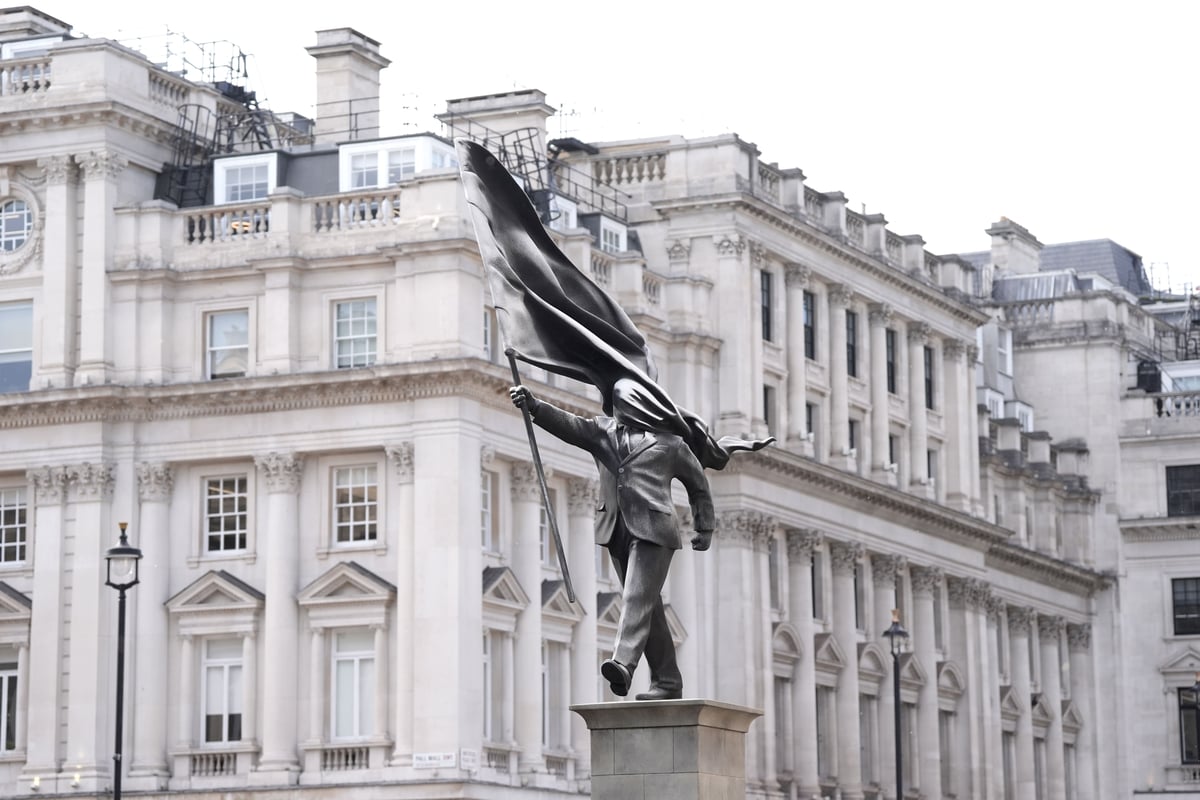
The artwork depicts a suited man in mid-stride, stepping off a stone plinth. However, the most striking feature is the man’s head, which is completely enveloped and “smothered” by a billowing flag.
- The Suit: Representing the “everyman” or perhaps a figure of the establishment—a civil servant, a politician, or a corporate worker.
- The Stride: A sense of forward motion, yet it is a blind progression. The figure is walking off the edge of the plinth, suggesting a precarious or even suicidal trajectory.
- The Flag: The fabric is rendered with such realism that it appears to be caught in a violent wind, tightly wrapping around the figure’s face, effectively blinding him to his surroundings.
Analyzing the Symbolism: What is Banksy Telling Us in 2026?
As we move through 2026, the political landscape remains as volatile as ever. Banksy’s “Blinded by the Flag” (as it has been colloquially dubbed) serves as a searing critique of nationalism and political tribalism.
The Danger of Blind Patriotism
By covering the man’s face with a flag, Banksy suggests that national identity can often act as a veil, preventing individuals from seeing the reality of their actions or the direction in which they are headed. The man is striding forward with confidence, yet he is entirely unable to see the “drop” at the edge of the plinth.
A Dialogue with History
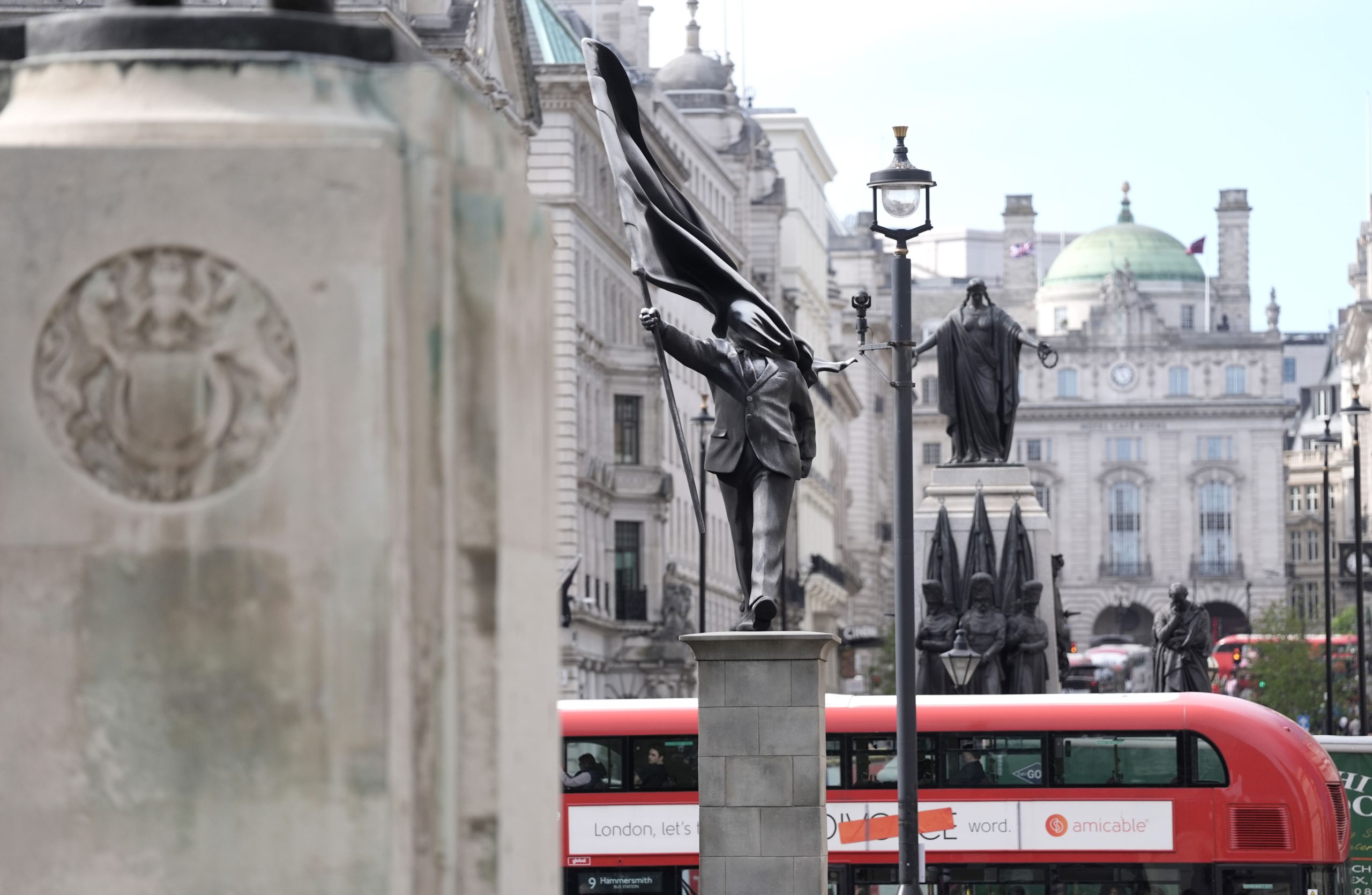
The choice of location is far from accidental. Waterloo Place is home to several traditional bronze statues, including:
Edward VII: The embodiment of royal lineage and colonial history.
Florence Nightingale: The “Lady with the Lamp,” representing Victorian virtue and service.
The Crimean War Memorial: A tribute to the fallen in a conflict often cited for its tactical blunders.
By placing his “unsolicited monument” among these giants, Banksy forces a confrontation between classical heroism and modern absurdity. While the surrounding statues celebrate clarity of purpose and historical legacy, Banksy’s figure represents the confusion and lack of vision in the contemporary era.
Banksy’s Recent Streak: From Murals to Monuments
The Waterloo Place statue is the latest in a series of high-profile interventions by the artist over the past several months. To understand the significance of this piece, one must look at the trajectory of Banksy’s work leading into 2026.
The Royal Courts of Justice Mural (September 2025)
Late last year, Banksy made headlines with a mural on the Queen’s Building within the Royal Courts of Justice complex. That piece depicted a protester lying on the ground with a blood-spattered placard while a judge loomed over them with a gavel. Interpreted as a commentary on the crackdown on Palestine Action protests, the art was swiftly covered by security, highlighting the tension between street art and judicial authority.
The Bayswater Figures (December 2025)
Just months before the Waterloo Place installation, two figures appeared on a building in Bayswater. These works continued Banksy’s exploration of human interaction in an increasingly digital and divided world.
Why the Shift to Sculpture?
While murals are easily painted over or removed, a multi-ton sculpture presents a much larger headache for authorities. By using a signature-etched plinth and heavy materials, Banksy is asserting a more permanent presence in the physical world. This shift suggests an artist who is no longer content with the ephemeral nature of spray paint and is instead looking to leave a “heavy” mark on the urban fabric.
Public and Official Reaction
As with any Banksy piece, the reaction has been polarized. Within hours of the artist’s confirmation, crowds gathered at Waterloo Place, turning the traffic island into an impromptu gallery.
Art Enthusiasts: Many praise the technical execution of the flag’s texture and the boldness of the placement.
City Officials: The “unsolicited” nature of the monument poses a legal dilemma. Does it constitute fly-tipping on a grand scale, or is it a gift to the city’s cultural heritage?
Security Experts: Questions have been raised regarding how a crane and lorry could operate in such a high-security zone without being intercepted by police, further adding to the “Banksy Mythos.”
The SEO Impact: Why “Banksy London Statue” is Trending
In the digital age, a Banksy reveal is as much a social media event as it is an art world moment. The search volume for “Banksy new statue London” and “Waterloo Place sculpture” skyrocketed within minutes of the Instagram post.
For the art market, this piece reaffirms Banksy’s status as the world’s most influential living artist. Despite decades of activity, he remains capable of capturing the global zeitgeist. The sculpture’s proximity to The Mall ensures it will be seen by millions of tourists, making it one of the most photographed spots in London for the foreseeable future.
Key Takeaways for Art Collectors and Fans:
Authenticity: The signature on the plinth and the Instagram video provide the necessary “COA” (Certificate of Authenticity) in the digital realm.
Value: If this piece were ever to hit the auction block, experts estimate its value in the tens of millions, given its scale and socio-political relevance.
- Conservation: Unlike his murals, which are often protected by Plexiglass, this sculpture is exposed to the elements, raising questions about how long it will remain in its original state.
Conclusion: A Visionary “Gap” Filled
Banksy’s latest contribution to the London landscape is more than just a prank or a piece of guerrilla art; it is a profound reflection on the state of the world in 2026. By filling a “gap” in Waterloo Place, he has exposed a much larger gap in our collective vision.
The man blinded by the flag serves as a haunting reminder that while we may be striding forward into the future, we must be careful not to let our ideologies blind us to the precipice ahead. Whether the statue remains for a week or a century, its impact on the cultural conversation is already set in stone.