The Preacher and the Perimeter: Analyzing the Conviction of Pastor Clive Johnston and the Future of Free Speech in 2026

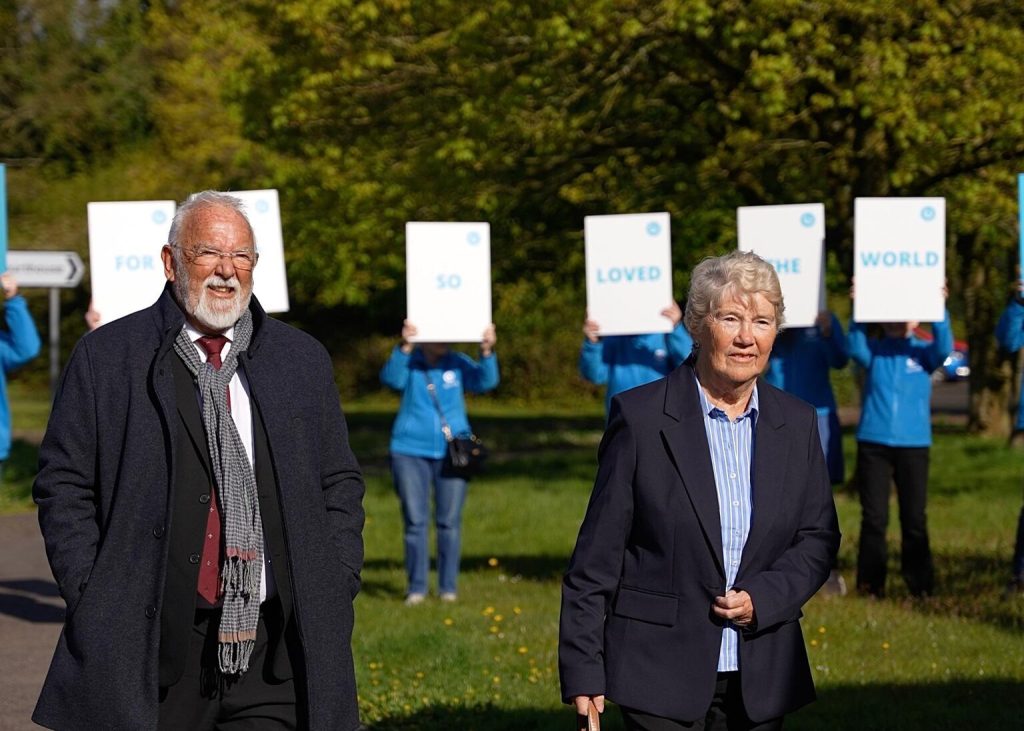
As we move through 2026, the legal landscape surrounding public expression and religious liberty in the United Kingdom continues to undergo a seismic shift. One of the most pivotal cases defining this era remains the conviction of Clive Johnston, a 77-year-old retired Baptist pastor and former President of the Association of Baptist Churches in Ireland.
His legal battle, which began at the gates of Causeway Hospital in Coleraine, has become a lightning rod for debates over the Abortion Services (Safe Access Zones) Act (Northern Ireland) 2023. This article provides a comprehensive analysis of the conviction, the legal nuances of “Safe Access Zones,” and the broader implications for civil liberties as we navigate the complexities of 2026.
The Incident: A Sermon Under the Shadow of the Law
On July 7, 2023, Pastor Clive Johnston stood near the entrance of Causeway Hospital. Armed with a microphone and a large crucifix, he began delivering a sermon. To Johnston, this was an act of “spreading the Gospel” and sharing “the light of Jesus.” To the Police Service of Northern Ireland (PSNI), it was a violation of a newly established legal boundary.
The Scene at Causeway Hospital
The court heard that Johnston was quoting passages from the Bible, specifically focusing on themes of hope and grace found in John 3:16. Body-worn camera footage from the scene captured the interaction between Johnston and PSNI Inspector O’Brien. The Inspector, described by the judge as exhibiting “almost endless patience,” repeatedly explained the new legislation and encouraged the pastor to move outside the designated Safe Access Zone (SAZ).
While others accompanying Johnston eventually complied and left the zone, the retired pastor remained. He informed the officers, “We are giving the word of God… I want the Government to know that there is a higher law.” This refusal to move led to a formal caution and, ultimately, a criminal prosecution that has echoed through the halls of Westminster and beyond.
Understanding the Legal Framework: The 2023 Act
To understand why a 77-year-old man of “good character” was criminalized for preaching, one must look at the Abortion Services (Safe Access Zones) Act (Northern Ireland) 2023. This legislation was designed to protect “protected persons”—patients and staff—from harassment, alarm, or distress when accessing abortion services.
What Constitutes a Safe Access Zone?
An SAZ typically extends 100 to 150 meters from the entrance of a facility providing abortion services. Within these boundaries, certain behaviors are strictly prohibited:
Direct or indirect influence: Any act intended to influence a person’s decision to attend or provide services.
Obstruction: Physically blocking access to the premises.
Harassment: Engaging in behavior that causes distress to those within the zone.
In Johnston’s case, the prosecution argued that his presence and his preaching were either intended to influence those entering the clinic or were reckless as to whether they would have that effect.
The Verdict: “Testing the Law to the Point of Breaking It”
In late 2024, District Judge Peter King delivered a 45-minute judgment at Coleraine Magistrates Court that effectively set the tone for how these cases would be handled in the years following.
The Judge’s Reasoning
Judge King was clear in his assessment: Clive Johnston had not stumbled into a violation; he had walked into it with intent. The judge noted that an email chain between Johnston and the PSNI prior to the incident proved the pastor was “fully aware” that his proposed actions might constitute an offence.
“Mr. Johnston tested the law, to the point where he broke the law,” Judge King ruled. The conviction rested on two primary charges:
- Conducting a prohibited act within an SAZ: Specifically, preaching with the intent or recklessness regarding its influence on protected persons.
- Failure to comply with a police direction: Refusing to leave the zone when instructed by Inspector O’Brien.
The “Recklessness” Standard
A crucial element of the conviction was the judge’s determination that Johnston was reckless. Under the law, the prosecution did not necessarily have to prove that a specific patient was deterred from entering the clinic. Instead, they had to prove that Johnston’s actions were likely to influence “any person” hearing the sermon, whether directly or indirectly.
The Defense: Religion, Speech, and the “Hierarchy of Courts”
The defense, supported by The Christian Institute, argued that the prosecution failed to prove that any “protected person” was even present at the clinic on the day of the sermon. They maintained that Johnston was not “protesting” in the traditional sense but was engaged in a religious service.
Constitutional and Human Rights Challenges
Johnston’s legal team sought to argue that the Safe Access Zone law was “outside the legislative competence” of the Northern Ireland Assembly. They claimed it infringed upon fundamental rights to freedom of religion and freedom of expression guaranteed under the European Convention on Human Rights (ECHR).
However, Judge King noted that the UK Supreme Court had already considered and rejected these arguments regarding the validity of the Act. He reminded the court that as a magistrate, he was bound by the decisions of higher courts, stating that the magistrates’ court sits on the “bottom rung” of the judicial hierarchy.
The Penalty
Following the conviction, Johnston was fined £450, plus a £15 offender levy. While the financial penalty was relatively small, the criminal record and the precedent it set were viewed as monumental by both supporters and critics of the law.
2026 Perspective: International Concern and the “Censorship” Debate
As we look at this case from the vantage point of 2026, the conviction of Pastor Johnston is no longer just a local Northern Ireland issue. It has become a case study in international reports regarding the decline of civil liberties in the UK.
The US State Department’s Watchful Eye
In 2025 and 2026, the United States State Department included the UK in its annual Human Rights Report, citing “serious restrictions on freedom of expression.” The report specifically mentioned the use of “buffer zones” or Safe Access Zones to criminalize religious speech.
The US government’s decision to “monitor” these prosecutions highlights a growing diplomatic tension. Critics argue that the UK, once a global beacon for free speech, is now adopting policies that equate peaceful religious expression with criminal harassment.
Political Fallout: DUP and the Christian Institute
The Democratic Unionist Party (DUP) has remained vocal in its support for Johnston. MP Gregory Campbell characterized the conviction as a “wake-up call” for the entire United Kingdom.
“Peaceful religious expression should never be treated as a criminal matter,” Campbell stated, arguing that the law lacks proportionality and common sense.
Ciarán Kelly, Director of The Christian Institute, labeled the ruling as “creeping censorship,” warning that if the law can criminalize a sermon on John 3:16, it can eventually be used to silence any dissenting voice in public spaces.
Analyzing the Impact on Public Ministry in 2026
The Johnston case has fundamentally altered how religious organizations operate in public spaces near healthcare facilities. By 2026, we have seen several key trends emerge:
1. The Chilling Effect
Many clergy members now express hesitation about holding open-air services or even wearing religious attire near hospitals, fearing that their mere presence could be interpreted as “reckless influence.” This “chilling effect” is exactly what civil liberties advocates warned about during the legislative debates in 2023.
2. Legal Precedents for “Silent Prayer”
Following Johnston’s conviction, other cases involving “silent prayer” inside buffer zones have made their way through the courts. The Johnston ruling provided a foundation for the argument that intent—even if unexpressed vocally—can be a criminal element if it occurs within the geographic boundaries of an SAZ.
3. Increased Police Discretion
The case highlighted the immense pressure placed on frontline police officers. While Inspector O’Brien was praised for his patience, the 2026 landscape shows an increasing reliance on police body-cam footage to “interpret” the intent of citizens, a practice that remains highly controversial.
The Road to Appeal: What Lies Ahead?
At the conclusion of the 2024 hearing, Judge King fixed bail for an appeal at £500. As of 2026, the legal journey for Clive Johnston continues to move through higher appellate courts. The outcome of these appeals will determine whether the “reckless influence” standard remains the law of the land or if the judiciary will demand a higher threshold for criminalizing speech.
Key Questions for the High Court:
Can a sermon be legally classified as a “protest” if it does not explicitly mention abortion?
Does the lack of a “protected person” at the scene invalidate the charge of influence?
Is the 100-meter zone a proportionate restriction on ECHR rights in a democratic society?
Conclusion: A Divided Society
The conviction of Pastor Clive Johnston remains one of the most significant legal events of the mid-2020s. It represents a collision between two protected sets of rights: the right of individuals to access healthcare without interference, and the right of individuals to express religious convictions in the public square.
In 2026, the “Safe Access Zones” are firmly established, but the moral and legal debate is far from over. For some, these zones are essential protections for women’s health. For others, they represent a “dark day for Christian freedom” and a dangerous step toward state-sanctioned censorship. As the appeals progress, the eyes of the world remain on Northern Ireland, waiting to see where the line between protection and liberty will finally be drawn.