Jerome Blake Injury Stuns Canada: A Look Back at the 2026 World Athletics Relays Drama

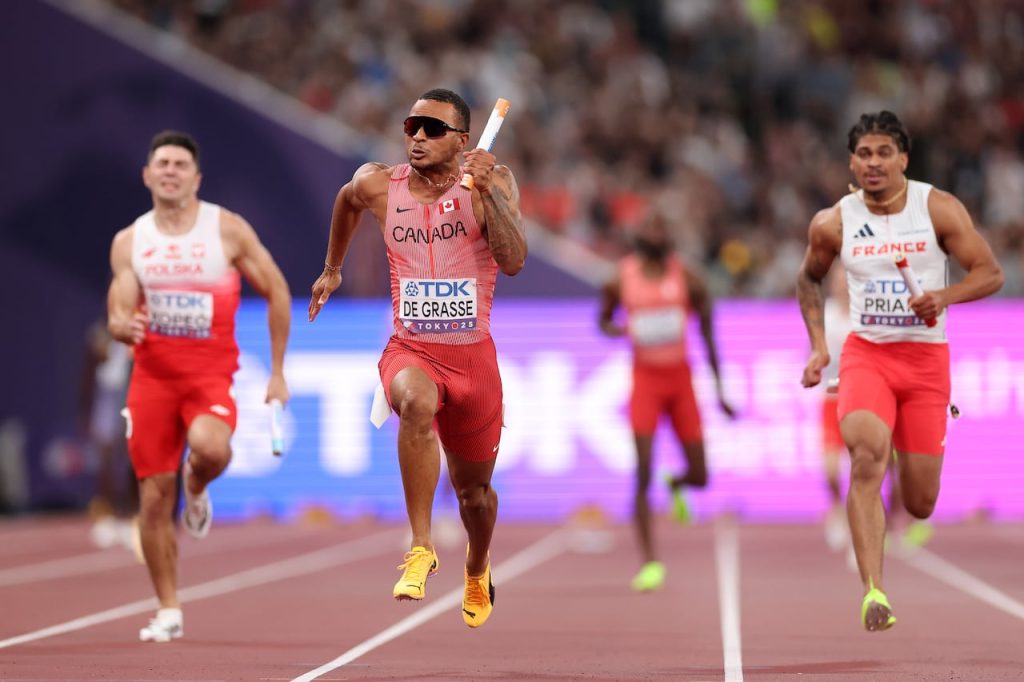
The track and field world was left holding its breath during the recent World Athletics Relays in Gaborone, Botswana. As the Canadian men’s 4×100-metre relay team took to the track, expectations were sky-high. Following a dominant performance in the qualifying rounds, the quartet looked poised for a podium finish. However, the final took a heartbreaking turn when Jerome Blake suffered a mid-race injury, forcing the team to limp across the finish line in seventh place.
This article explores the details of the incident, the implications for the Canadian sprint program, and how the team managed to persevere despite the setback.
The Moment the Race Changed
The men’s 4×100-metre final was shaping up to be a tactical masterclass. After securing a world-leading time of 37.56 seconds in their qualifying heat—just a hair off their Olympic-winning pace from Paris—the Canadian squad was in peak form.
As the second leg commenced, Jerome Blake, the Kelowna, B.C. native, began his acceleration with his trademark explosive power. Suddenly, disaster struck. Observers noticed Blake favouring his right leg midway through the straightaway. Despite the sharp pain, the veteran sprinter displayed immense grit, hobbling the remaining distance to successfully hand the baton to Brendon Rodney.
The delay caused by the injury was significant. Canada eventually clocked a time of 40.06 seconds, finishing seventh in a competitive eight-team field. While the result was disappointing, the collective effort to ensure the baton reached the finish line speaks volumes about the team’s professional culture.
Analyzing the Impact: Jerome Blake and the Canadian Sprint Core
Jerome Blake has been a cornerstone of Canada’s relay success for years. His performance leading up to the Botswana event suggested he was in the best shape of his life.
Recent Form and Personal Bests
Before the injury, Blake had been on an incredible trajectory:
Career-High Speed: At the Botswana Grand Prix held just one week prior, Blake stunned the field by winning the 100m in 9.93 seconds, shaving 0.02 off his personal best.
Elite Ranking: That 9.93-second run cemented him as the fourth-fastest 100m sprinter in Canadian history.
- Consistency: Having consistently dipped under the 10-second barrier, Blake’s presence on the second leg is usually the engine room of Canada’s relay strategy.
The loss of such a high-caliber athlete during the final is a massive blow to the team’s immediate momentum. However, the depth of the current Canadian roster, which features legends like Andre De Grasse and Aaron Brown, remains a point of optimism for the upcoming World Athletics Ultimate Championships.
The Competitive Landscape in Gaborone
The men’s 4x100m final was a high-stakes affair. The United States squad claimed victory, showcasing their depth by lowering the world-leading time to 37.43 seconds. South Africa followed closely in 37.49, with Germany taking bronze in 37.76.
Canada’s seventh-place finish is certainly not reflective of their true capability. In the previous year, the team had navigated a messy exchange between Aaron Brown and Blake, yet still managed to secure a bronze medal. This year, the focus was on technical precision, but physical health proved to be the uncontrollable variable.
Resilience Across the Board: Canadian Women and Mixed Teams
While the men’s 4x100m result was the headline, the broader Canadian delegation had a weekend defined by both triumph and narrow misses.
Women’s 4x100m Record-Breaker
The Canadian women’s 4x100m team put on a spectacular display, setting a new national record of 42.17 seconds. While they were edged out by a surging Jamaican team led by Elaine Thompson-Herah, the silver-medal performance highlighted the rapid improvement of Canada’s women’s sprinting program.
Mixed 4x400m Dominance
The highlight of the weekend for Canada was undoubtedly the mixed 4x400m relay. Led by anchor runner Dianna Proctor, the team secured a victory with a national record time of 3:12.43. Proctor’s ability to hunt down Belgium and Japan in the final 100 meters was arguably the most exciting athletic moment of the Gaborone meet.
Looking Ahead: The Road to the World Athletics Ultimate Championships
Despite the seventh-place finish in the 100m, the Canadian men’s team achieved the most important objective of the weekend: automatic qualification for the World Athletics Ultimate Championships in September.
With the team guaranteed a spot on the world stage, the medical staff will now turn their attention to Blake’s recovery. If the team can maintain the fitness levels shown by Andre De Grasse—who clocked a 19.84 in the 200m and a sub-10 second 100m—they remain a legitimate threat for the podium in September.
Key Takeaways for Canadian Athletics:
- Depth is Vital: The ability of the women’s and mixed teams to break national records shows that the Canadian pipeline is healthier than ever.
- Injury Management: Blake’s injury highlights the physical toll of the modern sprinting schedule; recovery protocols will be scrutinized heading into the autumn championships.
- Qualification Secured: Mission accomplished regarding the Ultimate Championships; the team can now focus on rehabilitation and tactical refinement.
Final Thoughts
The injury to Jerome Blake was a difficult moment to witness, especially given his recent personal-best form. However, track and field is as much about resilience as it is about speed. Canada’s relay teams have proven time and again that they can overcome setbacks, from messy baton exchanges to physical ailments. As they look toward the World Athletics Ultimate Championships later this year, the focus will shift from the disappointment in Botswana to the potential for glory on the global stage.
The Canadian sprint program remains one of the most exciting in the world. With a strong core of experienced veterans and rising stars, the team is far from done. Fans can expect a fierce comeback when the squad returns to action in September.