Heartbreak in Cleveland: How Injuries and a Third-Quarter Collapse Ended the Raptors’ 2026 Playoff Run

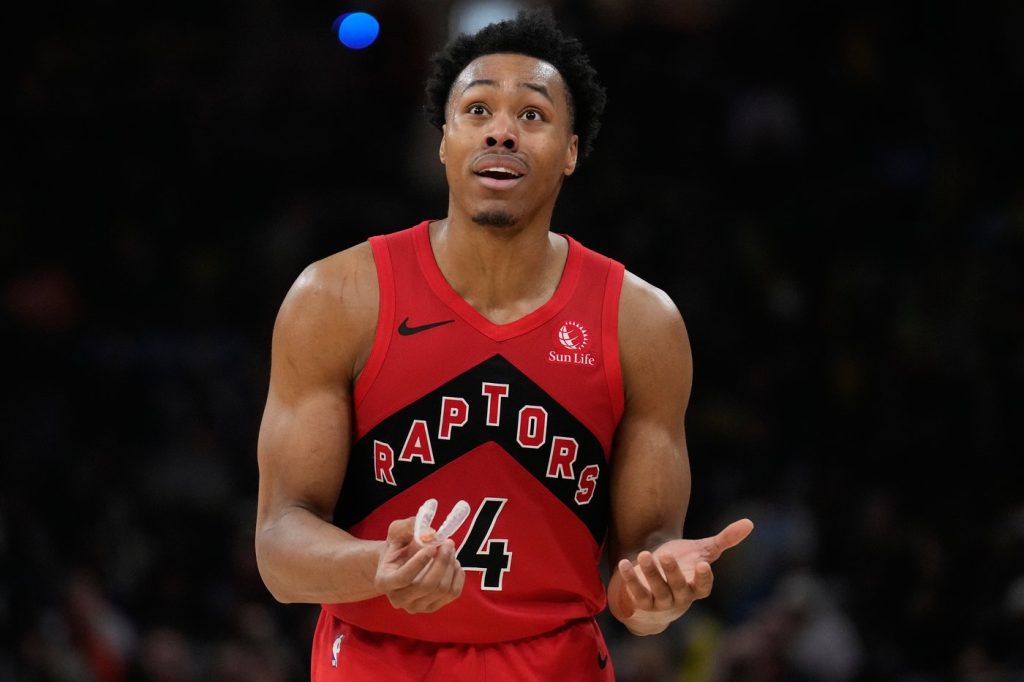
The 2026 NBA postseason journey for the Toronto Raptors came to a bitter, albeit promising, conclusion this Sunday night. In a high-stakes Game 7 against the Cleveland Cavaliers, the Raptors saw their playoff return—a four-year hiatus finally broken—snuffed out in a 114-102 defeat. Despite a valiant effort from the core duo of Scottie Barnes and RJ Barrett, the weight of a decimated rotation and a catastrophic third-quarter defensive lapse proved insurmountable.
For a team that fought its way back into the Eastern Conference spotlight, the loss serves as both a painful lesson and a foundational pillar for the future. As the dust settles in Cleveland, we look at what went wrong, who stepped up, and why this season remains a massive success for Toronto.
A Tale of Two Halves: The Anatomy of a Collapse
For the first 24 minutes, the Raptors looked like the superior team. Playing with poise and tactical discipline, Toronto grabbed an early lead, silencing the Cleveland crowd and forcing the Cavaliers to scramble. With 6:33 remaining in the second quarter, a layup by Jamal Shead pushed the Raptors ahead 41-31, signaling a potential upset.
However, the momentum shifted in the blink of an eye. Cleveland closed the first half on an 11-2 run, knotting the game at 49. If the first half was a testament to Toronto’s grit, the third quarter was a masterclass in volatility.
The Disastrous Third Quarter
The game effectively ended in the third frame, where the Cavaliers outscored the Raptors 38-19. The stats tell a harrowing story of offensive stagnation and defensive fatigue:
Field Goal Efficiency: The Raptors shot a dismal 5-of-20 from the floor.
Perimeter Struggles: Toronto went just 1-of-7 from beyond the arc.
The Rebounding Battle: Cleveland dominated the glass, grabbing nine offensive rebounds in the quarter alone—more than the total rebounds the Raptors managed in that same period.
“They worked harder than us in this game,” Scottie Barnes noted post-game. “They had 20 offensive rebounds. They had four guys crashing every play… the offensive rebounds were giving them extra possessions.”
The Injury Toll: A Roster Thinning at the Wrong Time
It is impossible to analyze this Game 7 loss without addressing the elephant in the room: the Raptors were severely shorthanded. The absence of All-Star forward Brandon Ingram—sidelined by a bruised right heel—left a massive hole in Toronto’s wing scoring and defensive versatility.
Furthermore, the loss of floor general Immanuel Quickley for the entire series robbed the Raptors of their primary playmaker and perimeter defender. When your rotation is forced to rely on rookies and second-year players in a pressure-cooker Game 7, the margin for error shrinks to near zero.
The Silver Lining: Barnes and Barrett Shine
Despite the elimination, the series showcased the absolute ceiling of the Raptors’ current core. Scottie Barnes, acting as the team’s heartbeat, put up 24 points in the final game, capping off a series where he averaged 24.1 points, 6.1 rebounds, and 8.6 assists.
RJ Barrett was equally clinical, adding 23 points in the finale and proving himself as a high-stakes performer. His legendary 3-pointer in the previous game—a shot that forced this Game 7—will be remembered as one of the highlights of the 2026 playoffs.
Emerging Talents
One of the most encouraging takeaways from this series was the development of the “second group.” Players like Jamal Shead and Ja’Kobe Walter were thrust into the fire, starting multiple games and holding their own against a veteran Cleveland squad. Shead’s 14-point first-half outburst and Walter’s 13-point performance (10 of which came in the second half) proved that the Raptors’ developmental pipeline is operating at an elite level.
Looking Ahead: The Path to 2027
Coach Darko Rajakovic was quick to shift the narrative from disappointment to development. While the locker room was understandably hurt by the loss, the internal sentiment is that this season was an “absolute success.”
Establishing a Culture: The team cemented its identity as one of the hardest-working, most resilient units in the NBA.
Playoff Experience: For many of these young players, this was their first taste of high-intensity, seven-game series basketball. That experience is invaluable.
Growth Potential: As Rajakovic stated, “This is not the best version of Scottie we’re going to see. He’s going to be even better next season.”
The Raptors are no longer a team in transition; they are a team on the rise. With a healthy Ingram and Quickley returning next year, combined with the newfound experience of their young bench, Toronto is positioned to be a legitimate contender in the Eastern Conference.
Final Thoughts
While the 2026 season ends with a Game 7 heartbreak, the Toronto Raptors have successfully signaled their return to relevancy. The brutal third-quarter collapse and the injury list will be the talking points of the offseason, but the grit shown by Barnes, Barrett, and the younger core is what will define their future. The Raptors didn’t just compete in this series; they grew in it. And for a city that lives and breathes basketball, that is a promise of better things to come.